AI estimate as of July 10, 2025 · verify with a professional before acting
AI-Generated · Verify before acting
Everything on this page is generated by AI for informational purposes only. AI can make mistakes — the AI may misidentify items or misattribute them (artist, maker, brand, designer, origin, era). This is not an official valuation and should not be used for insurance, sale, tax, estate, legal, or lending purposes — or any decision requiring a certified appraisal. It is not an authoritative claim about any person, brand, or rights holder — do not share or rely on it as a factual statement about a third party. Always consult qualified professionals before making financial decisions.
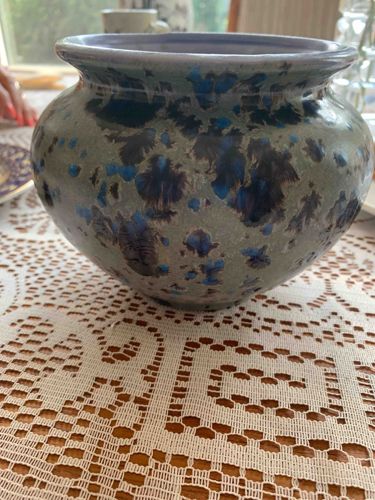
This is a round, squat ceramic vase or pot, likely intended for holding flowers or as a decorative accent. Its dimensions appear to be medium-sized, possibly 6-8 inches in height and 8-10 inches in diameter at its widest point, judging by its apparent scale relative to the tablecloth. The material is clearly ceramic, exhibiting a robust, probably stoneware or earthenware, body. The predominant base color of the glaze is a muted, desaturated green or gray-green, creating a somewhat earthy and neutral foundation. Overlaid on this base color are distinctive, splotchy patterns of darker blue and purplish-blue. These irregular splashes appear to be part of a 'crystalline' or 'speckled' glaze effect, where pigments separate and crystallize during firing, creating unique and organic visual textures. The mouth of the vase is relatively wide and features a subtly flared rim, suggesting functionality for various floral arrangements. The surface has a noticeable glossy or semi-glossy finish, indicating a well-fired glaze. There are no obvious visible condition issues such as chips, cracks, or significant abrasions on the exterior surface. The craftsmanship appears to be good, with a smooth and even application of the base glaze and a uniform distribution of the speckled effect, suggesting either skilled hand-crafting or a well-controlled manufacturing process. While no specific maker's marks or signatures are visible from this single angle, the style of the glaze suggests a mid-to-late 20th century aesthetic, or perhaps a contemporary piece inspired by traditional pottery techniques. The overall impression is one of rustic elegance, with the vivid blue spots providing an interesting contrast to the calm base color.
AI Appraisal Report
Upon examining the image of this Speckled Glaze Ceramic Vase, I assess it as a well-crafted decorative piece. The condition appears excellent, with no visible chips, cracks, or significant wear. The glossy finish and even glaze application suggest good firing and quality craftsmanship. Authenticity, based solely on visual inspection, points toward a genuine ceramic piece, not a reproduction of another material. However, without physical examination, I cannot confirm the specific clay body or firing temperature, nor can I verify any maker's marks that might be present on the base.
In terms of market conditions, similar mid-century modern or contemporary artisan ceramic vases with unique glaze effects typically find a receptive audience. Comparables would include hand-thrown pottery with specialized glazes, often sold in art galleries or designer home furnishing stores. The 'speckled' or 'crystalline' glaze effect is desirable and adds to its aesthetic appeal. Demand for unique, decorative ceramics remains steady, especially for pieces that can serve both functional and artistic purposes. Rarity is difficult to ascertain without knowing the maker; if it's a one-of-a-kind artisan piece, it would be rarer than a mass-produced item.
Factors significantly impacting value include its appealing color palette, good condition, and unique glaze. Absence of significant flaws enhances its marketability. My primary limitation is the inability to conduct a physical inspection for maker's marks, internal condition, or tactile assessment of the quality. For full authentication and a more precise valuation, I would require an in-person examination to check for signatures, assess the base, and verify the interior condition. Provenance documentation, if available, would further enhance its value and authenticity.