AI Appraisal Estimate

AI-generated estimates · not official valuations

From the user

What was submitted

Photo and notes provided by the user — not generated by AI

Submitted item photo
Submitted photo · June 15, 2026

User's notes

No additional notes provided.

AI analysis below

AI appraisal

AI analysis & estimate

AI-Generated · Verify before acting

Everything below is generated by AI for informational purposes only. AI can make mistakes — the AI may misidentify items or misattribute them (artist, maker, brand, designer, origin, era). This is not an official valuation and should not be used for insurance, sale, tax, estate, legal, or lending purposes — or any decision requiring a certified appraisal. It is not an authoritative claim about any person, brand, or rights holder — do not share or rely on it as a factual statement about a third party. Always consult qualified professionals before making financial decisions.

Read the full disclaimer

AI Identification

·Not independently authenticated·Verify before acting

United States Two Dollar Bill

Currency

AI Estimated Value

·Not an official valuation·Verify before acting

$2.00 - $3.00

As of June 15, 2026

AI Item Analysis

·AI can make mistakes·Verify before acting
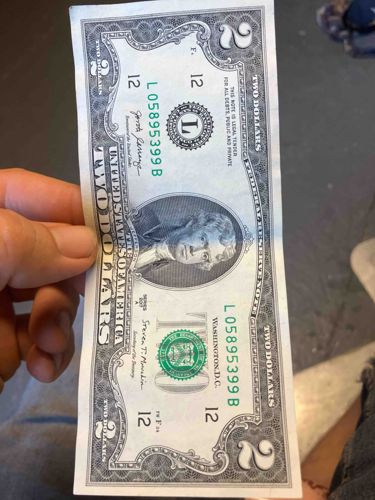
The item is a United States two-dollar bill (also known as a Two-Dollar bill or a Deuce). The front of the bill features a portrait of Thomas Jefferson, the third U.S. President. The bill is primarily green with black and white accents and intricate scrollwork borders. Notable features include the serial number L05895399 B, the signatures of the Treasurer of the United States and the Secretary of the Treasury, and the Federal Reserve Seal. The photo clearly shows the 'L' from the serial number and the letter within the Federal Reserve Seal, which appears to be 'F'. The condition appears to be circulated with some visible creasing and handling marks, which is typical for used currency. The denomination 'TWO DOLLARS' is prominently displayed. The bill is regulation size for U.S. currency. This specific note falls under the modern era of U.S. currency production. There are no apparent tears or significant damage visible in the image, but the overall crispness is diminished due to use. The craftsmanship is consistent with standard modern U.S. banknote printing.
AI Appraisal Report

·AI can make mistakes·Verify before acting
Based on my visual examination of the provided image, this United States Two-Dollar bill (Serial Number L05895399 B, Federal Reserve District 'L' or 'F') appears authentic in its design and printing, consistent with modern U.S. currency. The portrait of Thomas Jefferson, the intricate scrollwork, and the placement of serial numbers and seals align with expected features. The visible "L" from the serial number and the letter within the Federal Reserve Seal (appearing to be 'F' but partially obscured) are consistent with standard production. However, due to the limitations of image-based inspection, I cannot definitively confirm authenticity without a physical examination to assess paper type, ink characteristics under magnification, and security features not readily apparent in the image. The condition of the bill is clearly circulated. I observe multiple creases and handling marks throughout the note. There are no visible tears or major damage, but it lacks crispness. The market for circulated modern two-dollar bills is generally very close to face value. These notes are still produced in large quantities and are readily available. While some collectors seek specific serial numbers or print runs, a standard circulated example like this typically holds minimal premium over its $2 face value. Demand for such common notes is generally low among serious currency collectors. Factors significantly impacting value would include uncirculated condition, rare series dates, star notes, or unique errors, none of which this bill appears to possess based on the image. Without a physical inspection to confirm all security features, assess the paper feel and texture, and use magnification for printing details, a full authentication and precise condition grading is not possible. Provenance documentation, though less common for modern circulated currency, could hypothetically offer additional context but is unnecessary for a note of this type and condition in determining market value. Therefore, the appraisal is based solely on the visual evidence suggesting a standard circulated example.

Get your items appraised

Instant estimates of your treasures with AI-powered appraisals

Browse More Appraisals