AI Appraisal Estimate

AI-generated estimates · not official valuations

From the user

What was submitted

Photo and notes provided by the user — not generated by AI

Submitted item photo
Submitted photo · June 20, 2026

User's notes

No additional notes provided.

AI analysis below

AI appraisal

AI analysis & estimate

AI-Generated · Verify before acting

Everything below is generated by AI for informational purposes only. AI can make mistakes — the AI may misidentify items or misattribute them (artist, maker, brand, designer, origin, era). This is not an official valuation and should not be used for insurance, sale, tax, estate, legal, or lending purposes — or any decision requiring a certified appraisal. It is not an authoritative claim about any person, brand, or rights holder — do not share or rely on it as a factual statement about a third party. Always consult qualified professionals before making financial decisions.

Read the full disclaimer

AI Identification

·Not independently authenticated·Verify before acting

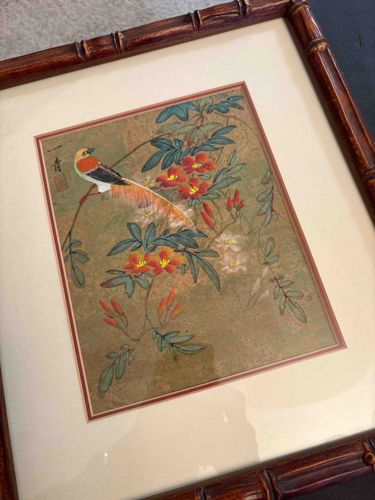
Framed Chinese Silk Painting of a Long-Tailed Pheasant and Hibiscus

Fine Art - Asian Paintings

AI Estimated Value

·Not an official valuation·Verify before acting

$250 - $450

As of June 20, 2026

AI Item Analysis

·AI can make mistakes·Verify before acting
This is a fine-quality Chinese painting on silk, executed in the 'Gongbi' (meticulous) style, featuring a vibrant long-tailed pheasant perched on a flowering branch. The artwork is rendered on a gold-toned or aged silk substrate that exhibits a subtle textural weave. The bird is meticulously detailed with a yellow crown, red neck, and a long, flowing tail in shades of orange and white. It is surrounded by lush green foliage and bright orange-red blossoms, possibly hibiscus or azalea flowers. In the upper left quadrant, there is a calligraphic inscription and a red cinnabar-style artist seal, indicating its provenance and authorship. The painting is professionally mounted with an off-white mat and a thin red accent border, housed within a mid-20th-century faux-bamboo carved wooden frame featuring a dark mahogany-colored finish. The silk shows minor evidence of even foxing and light toning consistent with age, likely dating it to the mid-20th century. The frame exhibits minor surface scuffs but remains structurally sound. The brushwork is delicate, demonstrating high technical skill in line-work and color layering, characteristic of traditional Chinese bird-and-flower subjects.

AI Appraisal Report

·AI can make mistakes·Verify before acting
This appraisal is based on my visual examination of the framed Chinese painting on silk depicting a long-tailed pheasant among hibiscus. The work is executed in the classic 'Gongbi' style, characterized by meticulous brushwork and precise detailing, particularly evident in the bird's plumage and the delicate veining of the leaves. The gilded tone of the silk substrate and the faux-bamboo frame strongly suggest this piece dates to the mid-20th century, a popular export period for such decorative works. The calligraphy and red artist seal appear consistent with traditional composition, though identification of the specific artist would require translation and comparison against artist indexes, which is difficult from the image alone. The condition appears good for its age, with noted minor foxing and toning that add character rather than detract significantly. The frame remains structurally sound with only minor cosmetic wear. Market conditions for decorative mid-century Chinese export paintings remain stable but modest; they are valued primarily for their aesthetic appeal in interior design rather than as high-value investment art. Comparable sales for similar anonymous or minor-artist decorative silk paintings of this size and framing generally fall between $150 and $400 at auction, with retail gallery prices potentially reaching $600. Significantly, to confirm a higher valuation or attribution to a master artist, a physical inspection is mandatory. I would need to examine the silk weave under magnification to rule out high-quality lithographic reproduction, which was common in this era. Additionally, a scholar's translation of the colophon is necessary to determine specific authorship. Without proven attribution or provenance, the value remains speculative and based on decorative merit.

Get your items appraised

Instant estimates of your treasures with AI-powered appraisals

Browse More Appraisals