AI Appraisal Estimate

AI-generated estimates · not official valuations

From the user

What was submitted

Photo and notes provided by the user — not generated by AI

Submitted item photo
Submitted photo · May 27, 2026

User's notes

Good condition vintage in

AI analysis below

AI appraisal

AI analysis & estimate

AI-Generated · Verify before acting

Everything below is generated by AI for informational purposes only. AI can make mistakes — the AI may misidentify items or misattribute them (artist, maker, brand, designer, origin, era). This is not an official valuation and should not be used for insurance, sale, tax, estate, legal, or lending purposes — or any decision requiring a certified appraisal. It is not an authoritative claim about any person, brand, or rights holder — do not share or rely on it as a factual statement about a third party. Always consult qualified professionals before making financial decisions.

Note

This analysis also relies on unverified notes provided by the user, which may be incomplete or inaccurate and could affect the result.

Read the full disclaimer

AI Identification

·Not independently authenticated·Verify before acting

Vintage East Asian Landscape Ink and Wash Painting

Fine Art - Asian Paintings

AI Estimated Value

·Not an official valuation·Verify before acting

$40 - $80

As of May 27, 2026

AI Item Analysis

·AI can make mistakes·Verify before acting
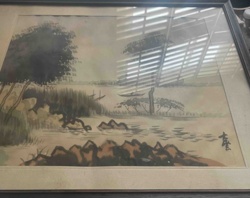
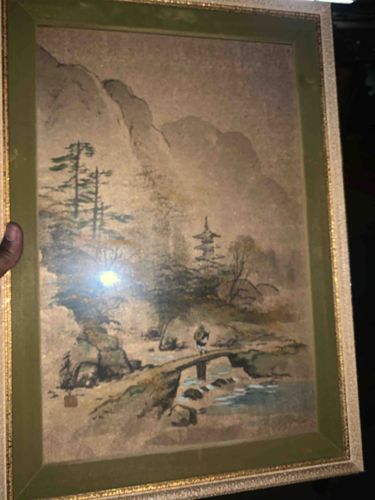
This is a vintage framed East Asian landscape painting, likely Japanese or Chinese, executed in a traditional ink and wash style on paper or silk. The composition features rhythmic mountain peaks, a multi-tiered pagoda, pine trees, and a lone figure crossing a small bridge over a stream. The color palette is muted, dominated by earth tones, greys, and subtle washes of green and blue. A red seal or 'chop' mark is visible in the lower left corner, indicating the artist's signature or studio. The artwork is housed in a mid-20th-century frame featuring a double-mat style: a wide olive-green inner border and a textured, off-white outer frame with a thin gold-toned interior lip. In terms of condition, there is visible foxing and discoloration across the paper's surface, particularly near the top, which is common for antique works on paper. The frame shows some minor edge wear and dust accumulation. The craftsmanship displays classic atmospheric perspective and delicate brushwork characteristic of Showa-era or early modern orientalist décor, reflecting a mid-to-late 20th-century aesthetic intended for global export or high-end domestic use.

AI Appraisal Report

·AI can make mistakes·Verify before acting
Based on a visual examination, this appears to be a vintage East Asian ink and wash landscape, likely of Japanese origin (Showa period) or a Chinese export piece, dating to the mid-to-late 20th century. The composition utilizes traditional sumi-e techniques, featuring standard motifs like towering peaks, a pagoda, and solitary figures, executed with competent but likely decorative brushwork rather than the hand of a master artist. The red chop mark in the lower-left corner acts as a signature or studio seal. The condition presents significant challenges to the valuation. There is widespread foxing (brown spotting) and general discoloration across the paper surface, particularly near the upper mountains, which suggests acidic exposure or humidity damage over time. While the mid-century frame with its olive-green matting is intact, the artwork itself has suffered environmental degradation that is difficult to reverse without costly conservation. In the current market, these pieces are often classified as decorative vintage art rather than high-value fine art collectibles. Similar unattributed or studio-produced landscapes from this era frequently appear in estate auctions and online marketplaces. Demand is driven primarily by aesthetic appeal for interior design rather than investment potential. Without identifying a specific, renowned artist from the seal—which would require clear macro photography and translation—the value remains modest. A definitive authentication would require physical inspection to determine if this is an original painting or a high-quality lithograph, and translation of the seal is necessary to rule out a known artist, though the style strongly suggests commercial production.

Get your items appraised

Instant estimates of your treasures with AI-powered appraisals

Browse More Appraisals