East Asian Ink and Wash Painting of Birds and Lotus
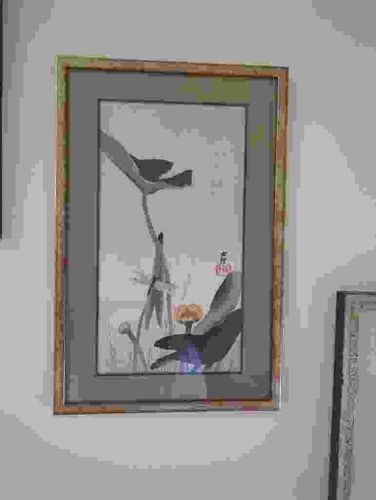
This is a rectangular, vertical-format ink and wash painting (sumi-e style) on paper or silk, professionally housed in a light-colored wood frame with a wide grey mat. The artwork depicts two birds perched upon a rhythmic, elongated stem or branch that curves toward the upper left. Below the birds, several large, expressive lotus leaves are rendered in broad, calligraphic brushstrokes of varying grey and black tones. A single, soft orange or vermilion lotus flower provides a focal point of color near the center-bottom of the composition. A red cinnabar artist seal (hank0) is clearly visible on the right center, accompanied by black calligraphic characters, indicating it is likely of Chinese or Japanese origin. The style suggests a mid-20th-century interpretation of traditional literati painting, emphasizing gestural brushwork and empty space. The physical condition appears stable, though there is a noticeable circular lens flare or reflection on the glass covering the lower quadrant. The frame shows minor surface handling marks consistent with age, but no major structural damage. The craftsmanship reflects a skilled hand familiar with Asian ink techniques, utilizing 'boneless' (mogu) application for the flower and expressive 'flying white' (feibai) techniques in the leaf stalks.
AI-Generated Appraisal Disclaimer
Estimated Value
$450 - $700
Basic Information
Category
Fine Art - Asian Paintings
Appraised On
February 17, 2026
Estimated Value
$450 - $700
Item Description
This is a rectangular, vertical-format ink and wash painting (sumi-e style) on paper or silk, professionally housed in a light-colored wood frame with a wide grey mat. The artwork depicts two birds perched upon a rhythmic, elongated stem or branch that curves toward the upper left. Below the birds, several large, expressive lotus leaves are rendered in broad, calligraphic brushstrokes of varying grey and black tones. A single, soft orange or vermilion lotus flower provides a focal point of color near the center-bottom of the composition. A red cinnabar artist seal (hank0) is clearly visible on the right center, accompanied by black calligraphic characters, indicating it is likely of Chinese or Japanese origin. The style suggests a mid-20th-century interpretation of traditional literati painting, emphasizing gestural brushwork and empty space. The physical condition appears stable, though there is a noticeable circular lens flare or reflection on the glass covering the lower quadrant. The frame shows minor surface handling marks consistent with age, but no major structural damage. The craftsmanship reflects a skilled hand familiar with Asian ink techniques, utilizing 'boneless' (mogu) application for the flower and expressive 'flying white' (feibai) techniques in the leaf stalks.
Get Your Items Appraised
Instant estimates of your treasures with AI-powered instant appraisals