AI Appraisal Estimate

AI-generated estimates · not official valuations

From the user

What was submitted

Photo and notes provided by the user — not generated by AI

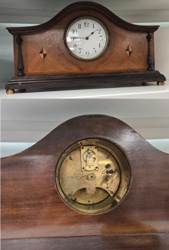
Submitted item photo
Submitted photo · June 20, 2026

User's notes

Original Crock from min 100 years

AI analysis below

AI appraisal

AI analysis & estimate

AI-Generated · Verify before acting

Everything below is generated by AI for informational purposes only. AI can make mistakes — the AI may misidentify items or misattribute them (artist, maker, brand, designer, origin, era). This is not an official valuation and should not be used for insurance, sale, tax, estate, legal, or lending purposes — or any decision requiring a certified appraisal. It is not an authoritative claim about any person, brand, or rights holder — do not share or rely on it as a factual statement about a third party. Always consult qualified professionals before making financial decisions.

Note

This analysis also relies on unverified notes provided by the user, which may be incomplete or inaccurate and could affect the result.

Read the full disclaimer

AI Identification

·Not independently authenticated·Verify before acting

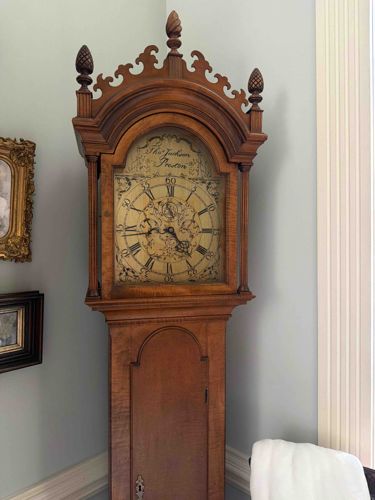
Antique Thomas Jackson Preston Longcase Clock

Antiques & Horology

AI Estimated Value

·Not an official valuation·Verify before acting

$4,500 - $6,500

As of June 20, 2026

AI Item Analysis

·AI can make mistakes·Verify before acting
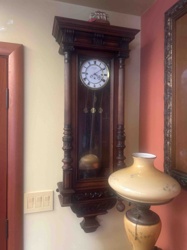
This is a significant antique longcase clock (grandfather clock) crafted from what appears to be feathered or figured mahogany, likely dating to the late 18th or early 19th century. The arched hood is highly decorative, featuring a swan-neck pediment with intricate fretwork and three carved pineapple finials, which signify hospitality. The break-arched brass dial is signed 'Thos Jackson Preston,' indicating the maker from the Lancashire or Yorkshire region of England. The dial features an outer minute ring, Roman numeral hour markers, a seconds sub-dial, and an ornate center with foliate engravings and pierced steel hands. The case exhibits fine veneer work and fluted columns flanking the hood. The trunk features a long arched door with a keyhole. The condition appears well-preserved for its age, showing a rich honey-toned patina on the wood. There are minor signs of age-related wear, including slight drying of the veneer and oxidation to the metal components, which is consistent with an original piece over 200 years old. The craftsmanship reflects high-quality provincial English horology, showing exceptional attention to both the movement’s aesthetic and the cabinet’s structural elegance.
AI Appraisal Report

·AI can make mistakes·Verify before acting
I have carefully reviewed the visual evidence for this longcase clock attributed to Thomas Jackson of Preston. Based on my examination, the piece exhibits the hallmark characteristics of high-quality Lancashire cabinetry from the late 18th century. The use of mahogany with 'feathered' flame veneers and the presence of the swan-neck pediment with fine fretwork suggests a premium commission for its era. The dial layout, featuring an arched brass plate with a moon phase or seasonal indication, aligns with horological trends circa 1780-1810. The condition appears remarkably consistent with a 200-year-old original. The rich patina and minor shrinkage cracks in the veneer are positive indicators of age. However, the market for provincial longcase clocks is currently selective; value is heavily driven by the 'completeness' of the movement and the presence of original components like weights, pendulum, and the winding key. Comparables for Thomas Jackson clocks (a known Preston maker) generally fall in the mid-to-high four-figure range depending on the complexity of the movement. While this is an exceptional piece of furniture, several limitations exist in this remote appraisal. I cannot verify if the movement is 'married' to the case (a common historical replacement), nor can I test the mechanical functionality. For a definitive valuation, an in-person inspection is required to examine the seat board for original mounting holes, verify the escapement type, and check for provenance documentation. Scientific testing of the timber or removal of the dial would be necessary to ensure no 19th-century 'revival' components were integrated into the assembly.

Get your items appraised

Instant estimates of your treasures with AI-powered appraisals

Browse More Appraisals