Large Industrial Tower Clock Face
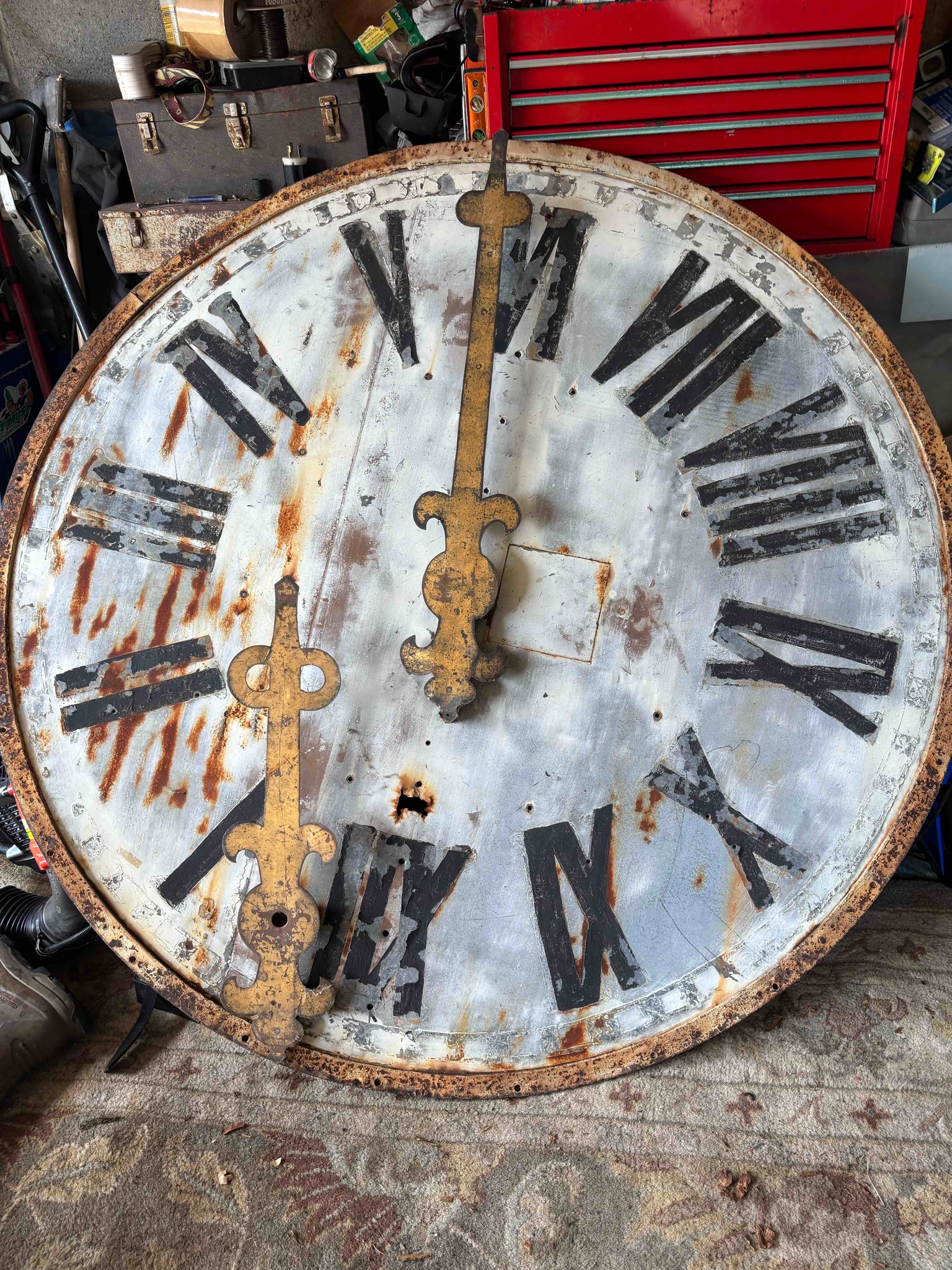
This is a significant oversized industrial clock face, likely salvaged from a tower, church, or railway station. It is constructed from a heavy circular metal sheet, finished with a weathered white/off-white enamel or paint. The face features prominent oversized Roman numerals hand-painted in black, which exhibit significant flaking and losses. The clock includes two large, ornate fleur-de-lis styled hands, currently detached or misaligned, which appear to be made of gold-toned or brass-plated metal. Physically, the item shows extensive signs of age and exposure; heavy rust and oxidation are present around the entire perimeter rim and bleeding into the face from various mounting holes and scratches. There is a notable square patch or repair plate visible in the center area, and a puncture hole is located near the six o'clock position. The overall craftsmanship suggests a late 19th to early 20th-century origin, designed for long-distance visibility. The heavy gauge of the metal and the scale of the hands indicate high-quality industrial fabrication intended for outdoor architectural integration. The patina is authentic and deep, characteristic of decades of environmental exposure.

AI-Generated Appraisal Disclaimer
Estimated Value
$4,500 - $6,500
Basic Information
Category
Antiques & Horology
Appraised On
April 10, 2026
Estimated Value
$4,500 - $6,500
Item Description
This is a significant oversized industrial clock face, likely salvaged from a tower, church, or railway station. It is constructed from a heavy circular metal sheet, finished with a weathered white/off-white enamel or paint. The face features prominent oversized Roman numerals hand-painted in black, which exhibit significant flaking and losses. The clock includes two large, ornate fleur-de-lis styled hands, currently detached or misaligned, which appear to be made of gold-toned or brass-plated metal. Physically, the item shows extensive signs of age and exposure; heavy rust and oxidation are present around the entire perimeter rim and bleeding into the face from various mounting holes and scratches. There is a notable square patch or repair plate visible in the center area, and a puncture hole is located near the six o'clock position. The overall craftsmanship suggests a late 19th to early 20th-century origin, designed for long-distance visibility. The heavy gauge of the metal and the scale of the hands indicate high-quality industrial fabrication intended for outdoor architectural integration. The patina is authentic and deep, characteristic of decades of environmental exposure.
Related Tags
Get Your Items Appraised
Instant estimates of your treasures with AI-powered instant appraisals