These notes were written by the person who submitted this item. Appraiser.AI has not verified them, and the AI's identification and estimate may rely on them.
AI Estimated Value
Not an official valuation
$150-250
AI estimate as of November 6, 2025 · verify with a professional before acting
AI-Generated · Verify before acting
Everything on this page is generated by AI for informational purposes only. AI can make mistakes — the AI may misidentify items or misattribute them (artist, maker, brand, designer, origin, era). This is not an official valuation and should not be used for insurance, sale, tax, estate, legal, or lending purposes — or any decision requiring a certified appraisal. It is not an authoritative claim about any person, brand, or rights holder — do not share or rely on it as a factual statement about a third party. Always consult qualified professionals before making financial decisions.
This analysis also relies on unverified notes provided by the user, which may be incomplete or inaccurate and could affect the result.
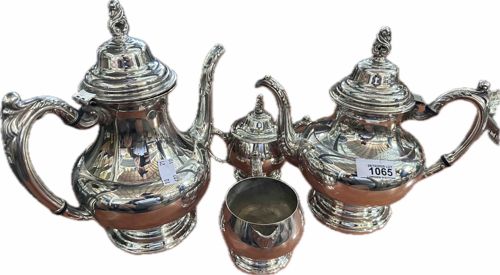
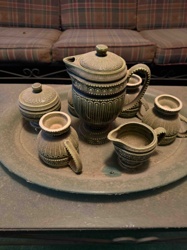
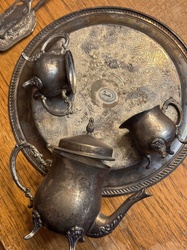
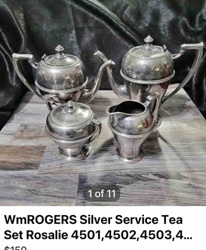
This is a four-piece silver-plated tea and coffee service set, likely manufactured by Oneida USA, as indicated by the contextual information. The set comprises a coffee pot, a teapot, a lidded sugar bowl, and an open creamer pitcher. Each piece exhibits a highly reflective, polished silver finish, suggesting either silver plating or sterling silver construction, though silver plating is more probable given typical mass-market items of this style. The design features a classic, somewhat ornate aesthetic, characterized by bulbous bodies, graceful C-scroll handles with decorative thumb rests, and elegant spouts. Both the coffee pot and teapot have hinged lids, each topped with an elaborate, possibly floral or acanthus leaf finial. The handles appear to be insulated with black material, although it's difficult to confirm from the image alone. The bases of all pieces are raised, with the coffee and teapots featuring more substantial, footed bases, while the sugar and creamer have simpler circular bases. The overall craftsmanship suggests a well-made, possibly mid-20th century to late 20th-century production. Visible condition issues include some reflections and potential smudges or minor tarnishing, but no significant dents, scratches, or loss of plating are obvious from the provided images. A white sticker with '1065' is visible on the teapot, suggesting an inventory or auction number. The set would have been used for formal tea and coffee serving occasions.
AI Appraisal Report
I have examined the provided image of this four-piece Oneida USA silver-plated tea and coffee service set, consisting of a coffee pot, teapot, lidded sugar bowl, and open creamer. Visually, the set presents as being in good overall condition. The highly reflective surface shows no obvious signs of significant dents, deep scratches, or plate loss from the image. Minor tarnishing or smudges are present, which is typical for silverplate and easily addressed. The classic, ornate design with C-scroll handles, elaborate finials, and insulated handles (as suggested by the black material) aligns well with Oneida's production during the mid-to-late 20th century.
From a market perspective, silver-plated tea and coffee sets, even from reputable manufacturers like Oneida, face moderate demand. While aesthetically pleasing for home decoration or occasional use, they do not command the same values as sterling silver sets due to the nature of the material. Comparables for similar Oneida silver-plated sets in good condition typically fall within the $100-$300 range, depending on the specific pattern and condition. This particular set appears to be a common, well-represented pattern, limiting its rarity.
Key factors impacting value include the 'Oneida USA' attribution, which confirms a known manufacturer, and the apparent good condition. The main limitation in my assessment is the inability to conduct a physical inspection. Without hands-on examination, I cannot confirm the exact material composition (e.g., if it's indeed plated, or potentially sterling in rare cases, though unlikely given the context), the presence of any minor dings or plate wear not visible in the image, or the integrity of the handle insulation. Furthermore, I cannot verify the authenticity of any maker's marks without a clear view. Full authentication would require an in-person examination to inspect hallmarks, assess overall structural integrity, and confirm material composition.