AI estimate as of August 31, 2025 · verify with a professional before acting
AI-Generated · Verify before acting
Everything on this page is generated by AI for informational purposes only. AI can make mistakes — the AI may misidentify items or misattribute them (artist, maker, brand, designer, origin, era). This is not an official valuation and should not be used for insurance, sale, tax, estate, legal, or lending purposes — or any decision requiring a certified appraisal. It is not an authoritative claim about any person, brand, or rights holder — do not share or rely on it as a factual statement about a third party. Always consult qualified professionals before making financial decisions.
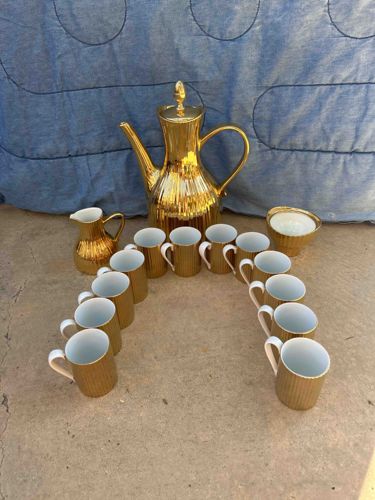
This is a comprehensive coffee or tea set, likely decorative given its highly polished, reflective gold finish. The set includes a tall, elegant coffee pot or dallah, a small creamer pitcher, a sugar bowl, and sixteen individual cups. All pieces share a consistent design, featuring a prominent ribbed or fluted exterior texture that gives them a distinctive vertical striped appearance. The main body of all items, including the pot, creamer, sugar bowl, and the exterior of the cups, is a bright, highly reflective gold, suggesting a metallic construction or plating over another material such as ceramic or brass. The interiors of the cups are stark white, providing a striking contrast to the opulent exterior and indicating they are likely crafted from porcelain or ceramic for practical use and ease of cleaning. The handles of the cups are also white, matching their interiors, and slender, offering a delicate aesthetic. The coffee pot has a slender, gracefully curved spout and a decorative finial on its lid. The overall condition appears excellent, with no visible signs of wear, dents, or tarnishing on the gold surfaces, and no chips or cracks on the white ceramic elements. The craftsmanship appears to be of good quality, with consistent fluting across all pieces and a high-gloss finish. The design suggests a mid-20th century to contemporary aesthetic, leaning towards a luxurious, possibly Middle Eastern (given the dallah-style pot) or European-inspired opulent style.
AI Appraisal Report
Based on my visual examination of the provided image, this Gold Ribbed Coffee/Tea Set appears to be in excellent condition. The highly reflective gold finish shows no visible signs of wear, tarnishing, or dents, and the white ceramic interiors of the cups and handles are free of chips or cracks. The consistent fluting across all pieces indicates good craftsmanship. Authenticity, based solely on visual inspection, suggests it is likely a decorative, possibly plated ceramic or metal set. The dallah-style pot combined with the opulent gold finish points towards a mid-20th century to contemporary aesthetic, potentially appealing to markets with a taste for luxurious or Middle Eastern-inspired decor.
Market conditions for such decorative coffee/tea sets are generally stable, with demand driven by interior design trends and gifting occasions. Comparable items, often mass-produced decorative sets, typically sell in the lower to mid-hundreds, depending on the number of pieces and perceived quality. The presence of sixteen cups makes this a more comprehensive set, adding to its utility and appeal. Rarity is likely low, as similar gold-tone decorative sets are not uncommon.
The primary factors impacting value are the excellent condition, the complete nature of the set, and its appealing decorative quality. However, without in-person examination, it's impossible to definitively determine the material composition (e.g., solid gold plating vs. a paint application, or the base metal/ceramic), which would significantly influence value. Full authentication would require a physical inspection to assess weight, material quality (e.g., precious metal content testing if claimed), and a thorough check for maker's marks or hallmarks. Provenance documentation could also shed light on its origin and historical significance, further cementing its value beyond a decorative item.