AI estimate as of August 22, 2025 · verify with a professional before acting
AI-Generated · Verify before acting
Everything on this page is generated by AI for informational purposes only. AI can make mistakes — the AI may misidentify items or misattribute them (artist, maker, brand, designer, origin, era). This is not an official valuation and should not be used for insurance, sale, tax, estate, legal, or lending purposes — or any decision requiring a certified appraisal. It is not an authoritative claim about any person, brand, or rights holder — do not share or rely on it as a factual statement about a third party. Always consult qualified professionals before making financial decisions.
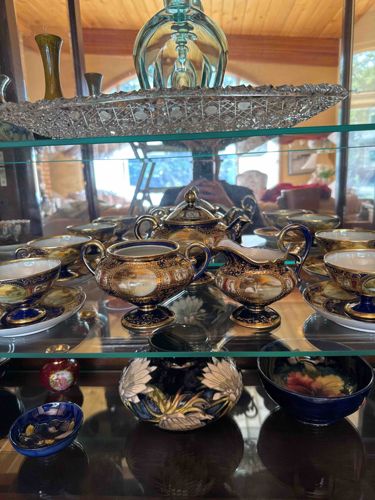
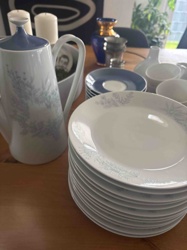
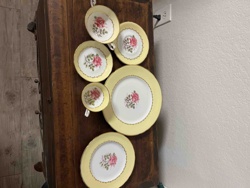
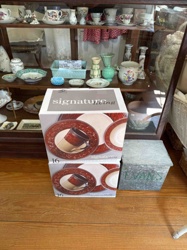
The item depicted is a partial antique or vintage tea/coffee service, predominantly featuring deep cobalt blue and extensive gilded decoration. The set includes a teapot, a lidded sugar bowl, a creamer, and several teacups with their accompanying saucers. Each piece is crafted from porcelain or fine china, exhibiting a rich, reflective gold-tone finish that suggests high-quality gilding, possibly hand-painted. The main bodies of the pieces are adorned with intricate, raised gold patterns, likely a rococo or baroque-inspired motif, contrasting dramatically with the blue accents on the rims, handles, and bases. The handles of the teapot, sugar bowl, and creamer are also heavily gilded, adding to their luxurious appearance. No specific maker's marks are visible in the image, but the craftsmanship points to a European origin, possibly from the late 19th or early 20th century, given the ornate style and extensive use of gold. The condition appears to be relatively good, with no obvious chips or cracks, although minor wear to the gilding is possible given its age. The items are displayed within a glass cabinet, suggesting they are valued collector's items. The design esthetic, heavy on ornamentation and rich color, is indicative of a period where such services were status symbols, demonstrating wealth and refined taste.
AI Appraisal Report
Upon my virtual examination of this Gilded Cobalt Blue Tea/Coffee Service, I note its striking aesthetic and apparent quality. The deep cobalt blue coupled with the extensive, possibly hand-painted, gold gilding suggests a luxury item from a significant period. The condition, from what I can discern through the image, appears to be relatively good, showing no obvious chips or cracks, which is encouraging for its age. However, some minor wear to the gilding, a common occurrence with such antique pieces, is likely.
Authenticity: Based on the visual cues—the ornate design, extensive gilding, and the general style—I am inclined to believe this set is a genuine antique or vintage European piece, likely late 19th to early 20th century. The craftsmanship speaks to a higher-end manufacturer, though the absence of visible maker's marks is a limitation.
Market Conditions & Comparables: Similar ornate tea services from known European manufacturers (e.g., Limoges, Meissen, Royal Vienna, or lesser-known but quality German or French producers) with good condition and extensive gilding typically command prices ranging from a few hundred to several thousand dollars, depending heavily on the maker, completeness of the set, and historical significance. The partial nature of this set (implied by 'several' cups/saucers rather than a full set for 6 or 12) slightly impacts its maximum value compared to a complete, pristine service.
Demand & Rarity: There is a consistent demand for well-preserved, aesthetically pleasing antique tea and coffee services, particularly those with strong visual impact like this cobalt and gold combination. The rarity is moderate; while many such sets were produced, finding one in this condition with such rich decoration is less common.
Factors Impacting Value: The primary positive factors are the excellent visual appeal, apparent good condition, and extensive gilding. The lack of a visible maker's mark is the most significant negative factor, as it prevents definitive attribution to a prestigious factory, which can significantly multiply value. Minor gilding wear, if present, would also be a slight detractor.
Limitations/Further Verification: It is crucial to iterate that this appraisal is based solely on visual examination of an image. For full authentication and a precise valuation, an in-person examination is paramount. This would allow me to: 1) Physically inspect for any hidden damage (e.g., hairline cracks, repairs, or more significant gilding loss), 2) Search exhaustively for maker's marks, even obscure or faint ones, 3) Assess the quality of the porcelain and gilding first-hand, and 4) Potentially conduct scientific testing on materials if provenance documentation is unavailable and attribution remains uncertain.