AI estimate as of October 30, 2025 · verify with a professional before acting
AI-Generated · Verify before acting
Everything on this page is generated by AI for informational purposes only. AI can make mistakes — the AI may misidentify items or misattribute them (artist, maker, brand, designer, origin, era). This is not an official valuation and should not be used for insurance, sale, tax, estate, legal, or lending purposes — or any decision requiring a certified appraisal. It is not an authoritative claim about any person, brand, or rights holder — do not share or rely on it as a factual statement about a third party. Always consult qualified professionals before making financial decisions.
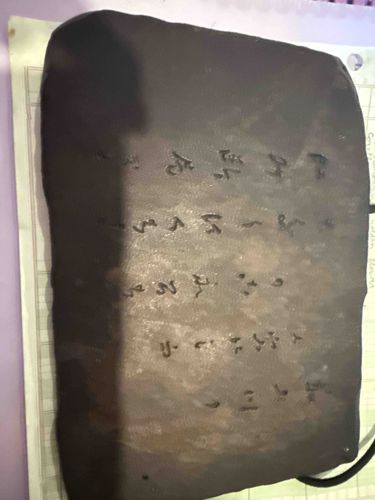
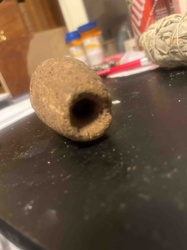
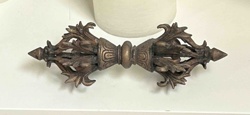
This item is a rectangular, flat stone tablet or plaque, appearing to be made of a dark, dense, and perhaps porous stone material, possibly slate, basalt, or a similar natural rock. Its color is predominantly dark grey to black, with some lighter greyish-brown hues and variations visible, suggesting natural stone coloration and possibly accumulated dirt or patina. The edges are somewhat irregular and uneven, indicating either a roughly cut, hand-chiseled, or naturally formed shape rather than a precisely manufactured one. The surface is relatively smooth but shows some minor textural inconsistencies. Etched or carved into the surface are multiple lines of what appear to be ancient or non-Latin script, possibly featuring characters or symbols that are curvilinear and intricate. There appear to be approximately four to five lines of text, with individual characters varying in size and spacing. The carvings seem to be of a consistent depth, suggesting they were made with a tool. There are no clear markings of a maker's signature or stamp. The overall condition suggests significant age, with the stone exhibiting a weathered appearance and some minor abrasions or scuffs consistent with handling over time. The inscribed characters themselves appear well-preserved despite the overall age of the piece. The absence of modern manufacturing marks strongly points to an artifact of historical or archaeological significance. Without a clearer image of the carvings, exact identification of the script or precise dating is difficult, but it possesses the characteristics of an ancient or traditional inscribed artifact. The item exudes an aura of antiquity, likely a cultural or historical relic.
AI Appraisal Report
Upon examining the provided image of this inscribed stone tablet/plaque, I observe an object of significant potential historical and cultural value. The material appears to be a dense, dark stone, likely slate or basalt, exhibiting natural variations and a weathered patina consistent with considerable age. The roughly cut, irregular edges suggest a hand-worked artifact rather than a machine-fabricated piece. The condition of the stone itself, while showing minor abrasions, indicates remarkable preservation for its apparent antiquity. The etched or carved script, comprising multiple lines, appears intricate and non-Latin, strongly suggesting an ancient or historically significant writing system. The consistency of carving depth further supports its authenticity as a deliberate inscription.
My assessment of authenticity, based solely on visual examination of the image, points towards a genuine artifact. The characteristics align with known ancient inscribed tablets. However, without a physical examination, I cannot definitively authenticate it. Market conditions for such unique artifacts are strong, especially for pieces with decipherable script or clear origin. Comparables include other ancient inscribed tablets, which can range from a few thousand to tens of thousands depending on provenance, historical significance, and decipherability. Demand for genuine historical artifacts remains high among private collectors and institutions, especially for unique pieces with potential cultural storytelling.
Key factors significantly impacting value would be the definitive identification of the script, its translation, and the cultural context of its origin. Rarity is inherent in such an item, as each inscribed tablet is unique. For full authentication and to establish a precise value, an in-person examination is crucial. This would allow for detailed material analysis, tool mark examination under magnification, and scientific dating methods (e.g., thermoluminescence, if applicable). Furthermore, robust provenance documentation detailing its discovery and ownership history would be indispensable. Without these, my valuation remains a preliminary assessment based on visual indicators alone.