These notes were written by the person who submitted this item. Appraiser.AI has not verified them, and the AI's identification and estimate may rely on them.
AI Estimated Value
Not an official valuation
$50 - $150
AI estimate as of October 23, 2025 · verify with a professional before acting
AI-Generated · Verify before acting
Everything on this page is generated by AI for informational purposes only. AI can make mistakes — the AI may misidentify items or misattribute them (artist, maker, brand, designer, origin, era). This is not an official valuation and should not be used for insurance, sale, tax, estate, legal, or lending purposes — or any decision requiring a certified appraisal. It is not an authoritative claim about any person, brand, or rights holder — do not share or rely on it as a factual statement about a third party. Always consult qualified professionals before making financial decisions.
This analysis also relies on unverified notes provided by the user, which may be incomplete or inaccurate and could affect the result.
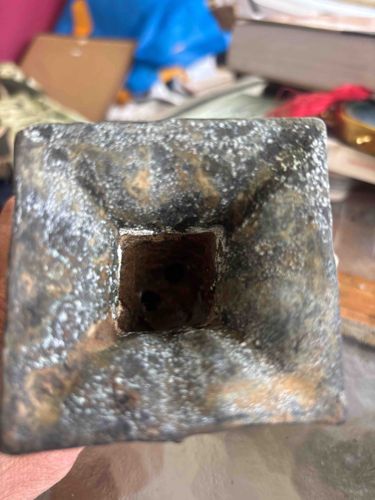
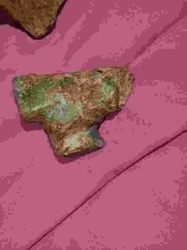
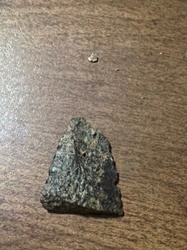
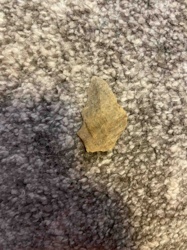
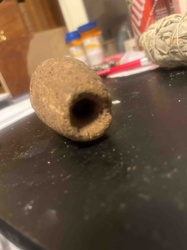
The item appears to be a fragment or a base of a larger ancient cast iron object, presenting a predominantly dark, mottled grey to black coloration with significant areas of white and light brown oxidation and corrosion. The visible section is square or rectangular in shape, forming a recessed, inward-sloping cavity or a socket in the center. The surface texture is rough and irregular, consistent with aged and heavily corroded cast iron. The white specks and larger patches suggest a significant buildup of mineral deposits or possibly a form of 'iron sickness' or degradation over a long period. The brown areas indicate rust. The edges appear somewhat rounded due to wear and corrosion, rather than sharply defined. The interior of the central cavity is dark and also shows signs of heavy corrosion, with additional irregular dark holes or voids visible within, suggesting a hollow core or internal structural features that are now heavily degraded. There are no discernible markings, signatures, or decorative elements visible in the provided images, indicating either a utilitarian purpose or that any original details have been obliterated by corrosion. Given the heavy oxidation and form, it is likely a very old artifact, possibly dating back to periods when cast iron was a prominent material for functional or structural applications. The overall condition suggests a significant amount of exposure to environmental elements, leading to extensive surface deterioration. The craftsmanship, though difficult to assess due to condition, appears to be consistent with ancient casting techniques, often characterized by a less refined surface finish compared to modern methods.
AI Appraisal Report
I have examined the provided image and the owner's details describing this item as a fragment of an ancient cast iron object, specifically a Chinese zun cup. The piece exhibits heavy corrosion, with a mottled dark grey to black coloration, significant white mineral deposits, and brown rust. The form suggests a base or a structural component with a recessed, inward-sloping cavity. The rough, irregular surface is consistent with ancient casting techniques and prolonged environmental exposure.
Assessing authenticity from an image alone is challenging. While the extensive corrosion and surface characteristics align with an aged cast iron artifact, the lack of discernible markings or decorative elements makes definitive identification difficult. The 'zun cup' attribution, if accurate, would typically imply a bronze ritual vessel with a flared rim and foot. This cast iron fragment, with its apparent square or rectangular base, does not immediately align with the typical form of a zun cup, which are usually round or square but rarely solely a heavy, corroded cast iron fragment of this nature. It might be a component of a much larger, functional cast iron piece. The 'iron sickness' visible further complicates its preservation.
Market demand for heavily corroded, unidentifiable fragments, even if ancient, is generally low. The primary interest would be academic or for specialized collectors of ancient metallurgical artifacts. Without clear provenance or more definitive form, its value is significantly diminished. Comparables for such fragments are scarce due to their limited collector appeal unless they originate from a historically significant site or exhibit unique characteristics.
Factors significantly impacting value negatively include its fragmentary nature, severe corrosion, and uncertain original form and purpose. Positively, the age suggested by the degradation is notable, but this does not outweigh the condition issues for general collectors.
To fully authenticate this piece and determine its precise origin and function, an in-person examination is crucial. This would allow for tactile assessment of material, detailed observation of surface pathology, and potentially forensic analysis of the corrosion products. Scientific testing (e.g., X-ray fluorescence for material composition, thermoluminescence dating for ceramic components if any, or metallurgical analysis) would be invaluable. Furthermore, robust provenance documentation linking it to a specific archaeological find or historical collection would dramatically increase its verifiable authenticity and, consequently, its value. Without these, it remains an interesting, yet largely unidentified, heavily degraded metal fragment.