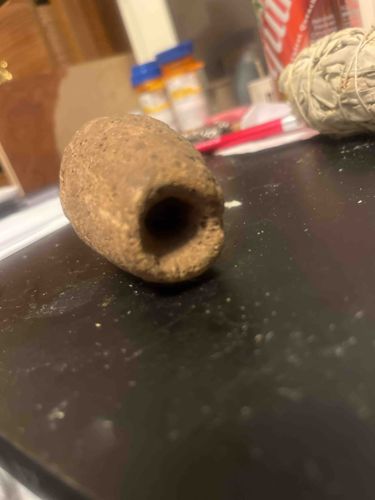
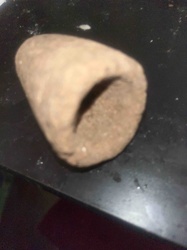
It has a hole bored all the way thru it is also tapered at one end
These notes were written by the person who submitted this item. Appraiser.AI has not verified them, and the AI's identification and estimate may rely on them.
AI Estimated Value
Not an official valuation
$50 - $150
AI estimate as of November 18, 2025 · verify with a professional before acting
AI-Generated · Verify before acting
Everything on this page is generated by AI for informational purposes only. AI can make mistakes — the AI may misidentify items or misattribute them (artist, maker, brand, designer, origin, era). This is not an official valuation and should not be used for insurance, sale, tax, estate, legal, or lending purposes — or any decision requiring a certified appraisal. It is not an authoritative claim about any person, brand, or rights holder — do not share or rely on it as a factual statement about a third party. Always consult qualified professionals before making financial decisions.
This analysis also relies on unverified notes provided by the user, which may be incomplete or inaccurate and could affect the result.
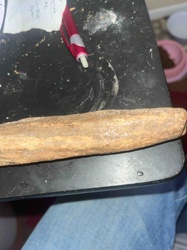
This item appears to be a fragment of a larger object, possibly a pipe bowl or a similar implement, crafted from a natural clay-like material. Its predominant color is a muted, earthy brown with visible speckles of lighter and darker inclusions, suggesting unrefined clay or a primitive firing process. The object is roughly cylindrical but tapers noticeably towards one end, forming a conical or bullet-like shape. A prominent, circular hole has been bored completely through the object longitudinally, indicating it was designed to accommodate the passage of air, smoke, or a rod. The interior of this bore is dark and appears to be smooth, suggesting either deliberate shaping or wear from prolonged use. The exterior surface is markedly textured and irregular, showing numerous small pits, indentations, and possibly remnants of organic material or coarse temper from its original composition. There are no discernible maker's marks, signatures, or decorative engravings. The overall condition suggests significant age and exposure, with a weathered appearance and a robust, unglazed surface. Given the apparent material and craftsmanship, it likely dates to an earlier period, possibly pre-industrial or Indigenous, and its primary use would have been functional rather than purely ornamental. The lack of refinement points to utilitarian origins. The object's weight cannot be determined from the image, but its physical characteristics suggest it is solid and dense.
AI Appraisal Report
Based on my visual examination of the provided image, this Tapered Clay Pipe Bowl Fragment, or similar implement, presents as a crude, utilitarian object. The earthy brown, speckled clay material and unrefined appearance strongly suggest an archaeological or folk art origin, likely pre-industrial or Indigenous. The complete longitudinal boring confirms its function as a conduit, possibly for smoking, a spindle weight, or part of a primitive tool. The textured, irregular exterior and lack of decoration point to its primary purpose being functional rather than aesthetic.
Its condition appears consistent with significant age and exposure; the weathered surface and robust, unglazed nature are typical of such artifacts. Authenticity is difficult to definitively confirm from images alone. While its characteristics are consistent with genuine artifacts of this type, I cannot rule out modern reproductions or natural curiosities without physical inspection. The absence of maker's marks or provenance documentation further complicates authentication.
In terms of market conditions, crude implements like this generally occupy a niche market. Comparables would include other unrefined clay pipe fragments, fishing weights, or simple tool components, typically found at archaeological digs or in folk art collections. Demand is modest, usually from specialized collectors of primitive tools, Indigenous artifacts, or historical archaeology enthusiasts. Rarity is difficult to assess; common utilitarian items, even if ancient, might not be exceedingly rare, though well-preserved examples can command higher prices. Key factors impacting value here are its material, apparent age, and confirmed utilitarian nature. The lack of refinement actually supports its authenticity as an older, functional piece.
For full authentication and a more precise valuation, a physical examination is crucial. This would allow for tactile assessment of material, weight, and density, and closer inspection of manufacturing marks or wear patterns not visible in images. Scientific testing (e.g., thermoluminescence dating for the clay) and strong provenance documentation (e.g., excavation records) would be paramount to verify its age and origin conclusively. Without these, the value remains conservative, reflecting the inherent uncertainties of remote appraisal.