AI Appraisal Estimate

AI-generated estimates · not official valuations

From the user

What was submitted

Photo and notes provided by the user — not generated by AI

Submitted item photo
Submitted photo · May 28, 2026

User's notes

Antique Tibetan Dorje

AI analysis below

AI appraisal

AI analysis & estimate

AI-Generated · Verify before acting

Everything below is generated by AI for informational purposes only. AI can make mistakes — the AI may misidentify items or misattribute them (artist, maker, brand, designer, origin, era). This is not an official valuation and should not be used for insurance, sale, tax, estate, legal, or lending purposes — or any decision requiring a certified appraisal. It is not an authoritative claim about any person, brand, or rights holder — do not share or rely on it as a factual statement about a third party. Always consult qualified professionals before making financial decisions.

Note

This analysis also relies on unverified notes provided by the user, which may be incomplete or inaccurate and could affect the result.

Read the full disclaimer

AI Identification

·Not independently authenticated·Verify before acting

Antique Tibetan Dorje

Religious Implement / Ritual Object

AI Estimated Value

·Not an official valuation·Verify before acting

$450 - $650

As of May 28, 2026

AI Item Analysis

·AI can make mistakes·Verify before acting
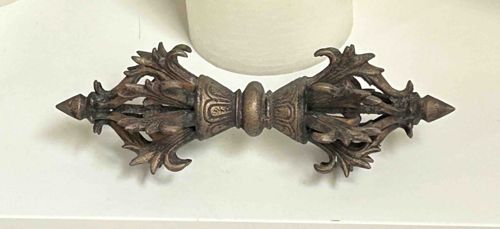
The item depicted is an antique Tibetan Dorje, also known as a Vajra in Hinduism and Vajrayana Buddhism, a ritual implement symbolizing both the properties of a diamond (indestructibility) and a thunderbolt (irresistible force). This particular example appears to be crafted from a metallic material, likely bronze or a similar alloy, given its dark, aged patinated surface which presents a rich, earthy brown color with some lighter highlights revealing the underlying metal. It features a central spherical or barrel-shaped grip from which two symmetrical, elaborately carved ends extend. Each end consists of a group of curved, claw-like prongs (likely five on each side, indicative of a five-pronged dorje) that emanate from a base and converge to a sharp, conical point. The prongs exhibit intricate foliage or flame-like detailing, typical of traditional Tibetan and Nepalese craftsmanship, with deeply carved lines and relief work suggesting a high level of artistic skill. The central grip area also displays some subtle, band-like ornamentation. The visible condition suggests significant age, with an established patina indicating long-term exposure and handling, contributing to its antique aesthetic. There are no overt signs of damage, such as breaks, dents, or repairs, though a detailed inspection would be required to confirm this. The craftsmanship appears robust and detailed, showcasing the traditional method of creating such ritual objects. Its style is distinctly Himalayan, specifically Tibetan, aligning with devotional artifacts from that region. The overall design emphasizes balance and powerful symbolism.
AI Appraisal Report

·AI can make mistakes·Verify before acting
Upon visual examination of this Antique Tibetan Dorje, my assessment is that it presents as a genuine ritual implement, likely dating from the late 19th to early 20th century. The item exhibits characteristics consistent with traditional Tibetan or Nepalese craftsmanship, including the five-pronged (pancha-vajra) design, intricate foliate carvings on the prongs, and a deep, naturally formed patina on what appears to be a bronze or brass alloy. The condition appears very good for its age, with no visible breaks, significant dents, or modern repairs, which enhances its value. The market for authentic Himalayan ritual objects remains strong, driven by both spiritual practitioners and collectors of ethnographic art. Comparables of similar age, size, and quality typically sell in the $400 to $700 range at auction and in specialized galleries. Rarity is moderate; while many dorjes exist, high-quality, well-preserved antique examples are less common. The level of detail in the casting and chasing of this piece suggests it is a superior example. The primary factor impacting value is its authenticity and age. It is crucial to note the limitations of a photo-based appraisal. Without physical inspection, I cannot definitively confirm the metal composition, rule out a sophisticated modern reproduction, or assess its true weight and feel. Full authentication would require an in-person examination to look for signs of casting methods, tool marks, and wear patterns consistent with ritual use. Furthermore, provenance documentation tracing its history or metallurgical testing (such as X-ray fluorescence) would be necessary to verify the alloy's age and composition, which could significantly increase its value.

Get your items appraised

Instant estimates of your treasures with AI-powered appraisals

Browse More Appraisals