AI Appraisal Estimate

AI-generated estimates · not official valuations

From the user

What was submitted

Photo and notes provided by the user — not generated by AI

Submitted item photo
Submitted photo · May 25, 2026

User's notes

No additional notes provided.

AI analysis below

AI appraisal

AI analysis & estimate

AI-Generated · Verify before acting

Everything below is generated by AI for informational purposes only. AI can make mistakes — the AI may misidentify items or misattribute them (artist, maker, brand, designer, origin, era). This is not an official valuation and should not be used for insurance, sale, tax, estate, legal, or lending purposes — or any decision requiring a certified appraisal. It is not an authoritative claim about any person, brand, or rights holder — do not share or rely on it as a factual statement about a third party. Always consult qualified professionals before making financial decisions.

Read the full disclaimer

AI Identification

·Not independently authenticated·Verify before acting

Fused Molten Metal and Glass Artifact

Historical Artifact / Fire Salvage Relic

AI Estimated Value

·Not an official valuation·Verify before acting

$150 - $300

As of May 25, 2026

AI Item Analysis

·AI can make mistakes·Verify before acting
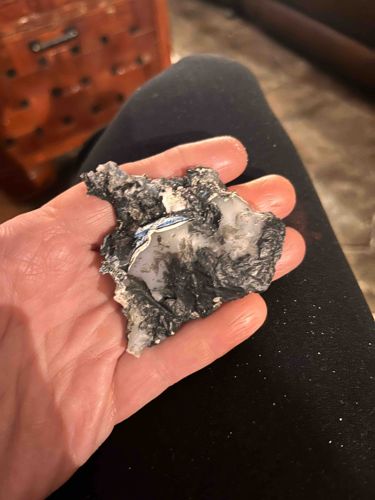
This object is a palm-sized conglomerate of fused materials, appearing to be a mix of metallic slag and vitreous components. The specimen measures approximately 2 to 3 inches in width and exhibits a highly irregular, amorphous shape. It features a dark, charcoal-gray to black metallic matrix with a bubbly, vesicular texture characteristic of molten metal that has rapidly cooled. Interspersed within this dark cluster are segments of opaque white and translucent grayish material, likely glass or ceramic, which shows signs of melting and flow. Notably, there is a distinct curved band or rim visible on the left side with a thin line of blue decoration, suggesting a fragment of porcelain or glazed pottery that has been subjected to extreme heat. The surface is jagged and unpolished, showing no specific maker's marks or stamps due to the heat deformation. Its condition is that of a post-disaster artifact, likely formed during a high-intensity fire where household items or industrial components melted together. The aged appearance and oxidation of the metal suggests it may be a historical relic from a significant fire event. The craftsmanship is accidental, resulting in a unique, non-repeating geological-like form that captures a specific moment of destruction.
AI Appraisal Report

·AI can make mistakes·Verify before acting
I have examined the digital images of this fused conglomerate, a striking example of a 'disaster relic' likely originating from a high-intensity conflagration. The specimen shows classic hallmarks of rapid thermal cooling, including a vesicular (bubbly) metallic matrix and the distinct vitrification of ceramic fragments. The presence of a curved porcelain rim with blue underglaze decoration is a significant diagnostic feature, suggesting a domestic context rather than purely industrial slag. The condition is consistent with an 'as-found' historical artifact; the oxidation layers and embedded debris appear authentic to a long-term post-disaster recovery. The market for fire salvage is niche, driven heavily by provenance. Without documented association with a major historical event (e.g., the Great Chicago Fire or the San Francisco Earthquake), the object's value is primarily aesthetic and curiosity-based. Comparables for anonymous fire-fused clusters typically sell in the $75–$150 range. However, the visible porcelain remnant elevates this piece for collectors of 'curiosity cabinet' items. Limitations of this appraisal: A definitive valuation is hampered by the lack of provenance. From images alone, I cannot verify the chemical composition of the metal or the age of the blue pigment. To achieve full authentication and potentially higher value, an in-person examination is required to check for 'synthetic aging' (artificial patinas). Scientific testing, such as X-ray fluorescence (XRF) to identify the alloy or microscopic analysis of the glaze, would be necessary to link it to a specific era. Provenance documentation, such as a find-site location or family history, would be the primary factor in increasing the market value beyond its current curiousity-level status.

Get your items appraised

Instant estimates of your treasures with AI-powered appraisals

Browse More Appraisals