AI estimate as of August 26, 2025 · verify with a professional before acting
AI-Generated · Verify before acting
Everything on this page is generated by AI for informational purposes only. AI can make mistakes — the AI may misidentify items or misattribute them (artist, maker, brand, designer, origin, era). This is not an official valuation and should not be used for insurance, sale, tax, estate, legal, or lending purposes — or any decision requiring a certified appraisal. It is not an authoritative claim about any person, brand, or rights holder — do not share or rely on it as a factual statement about a third party. Always consult qualified professionals before making financial decisions.
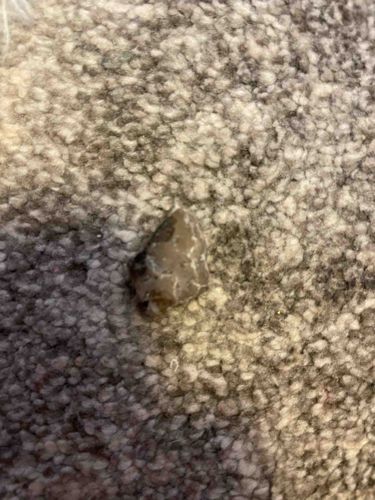
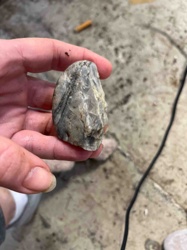
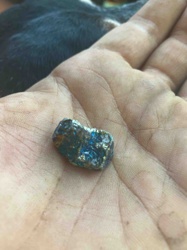
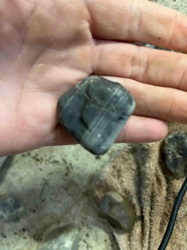
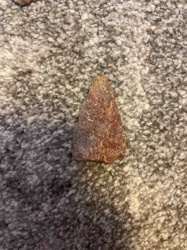
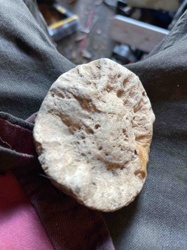
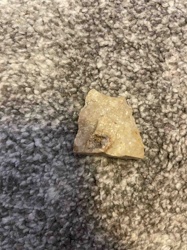
The item appears to be a small, irregularly shaped fragment of a mineral or rock. It exhibits a muted palette of earthy tones, primarily grays, browns, and possibly some very light cream or off-white areas. The surface texture is uneven, suggesting a natural break or fracture, rather than a polished or worked finish. There are visible variations in color across its surface, with some regions appearing darker and others lighter, indicative of different mineral inclusions or weathering patterns. A notable feature is a lighter, almost whitish, veining or crystalline structure running through a darker, more solid-looking matrix. This could suggest either a quartz inclusion or another vein mineral within a host rock. The edges appear somewhat rounded in places, perhaps from natural tumbling or erosion, while other sections maintain sharper, angular breaks. There are no discernible markings, inscriptions, or signs of human modification, such as tool marks or polished facets. Its small size suggests it could be a piece of gravel, a chipped-off fragment from a larger rock, or a naturally occurring small stone. The overall condition appears natural, with no obvious signs of significant damage beyond naturally occurring breaks and wear. It lacks any particular shine or luster, suggesting it is not a metallic mineral or a highly crystalline jewel. The background it rests upon is a textured, looped-pile carpet in various shades of gray and white, providing a sense of scale, although precise measurements are not possible from the image.
AI Appraisal Report
Upon visual examination of the provided image, this unidentifiable rock fragment presents as a naturally occurring, unworked specimen. Its earthy tones, irregular shape, and presence of veining suggest a common geological origin, likely a piece of weathered host rock with mineral inclusions. The absence of human modification, polished surfaces, or discernible unique features points to a natural break, possibly from a larger rock formation or gravel.
Authenticity: Based solely on the image, the item appears authentic as a natural rock fragment. There are no indications of artificial alteration or manufacturing. However, without in-hand inspection, it's impossible to verify its mineralogical composition, geological origin, or if it has been treated in any way (though unlikely for such an item). Full authentication, if desired for scientific purposes, would require X-ray diffraction, spectroscopy, or petrographic analysis to identify specific minerals, and a geological context. Provenance documentation would be necessary if its origin within a significant geological site were claimed.
Market Conditions & Comparables: The market for unidentifiable, common rock fragments is virtually non-existent for collectors. Comparables would include decorative gravel, landscaping stones, or common mineral specimens found widely. These typically have negligible value unless they possess exceptional aesthetic qualities (e.g., unique banding, vibrant colors) or known scientific significance (e.g., meteorites, rare mineral samples), neither of which is evident here. Demand is extremely low; it is not a sought-after collecting category. Rarity is also extremely low; similar fragments are ubiquitous in natural environments.
Factors Impacting Value: The primary factors driving its negligible value are its common appearance, lack of identifiable unique features, absence of rarity, and no intrinsic scientific or aesthetic appeal. Its small size further limits any potential utility. This is a common stone fragment.
Limitations: My assessment is entirely based on the visual information in the single provided image. I cannot determine precise mineralogy, weight, exact dimensions, or true surface texture. These limitations are critical in appraising geological specimens. Without physical examination and potential scientific testing, any claims beyond 'it's a rock' are speculative.