AI estimate as of August 14, 2025 · verify with a professional before acting
AI-Generated · Verify before acting
Everything on this page is generated by AI for informational purposes only. AI can make mistakes — the AI may misidentify items or misattribute them (artist, maker, brand, designer, origin, era). This is not an official valuation and should not be used for insurance, sale, tax, estate, legal, or lending purposes — or any decision requiring a certified appraisal. It is not an authoritative claim about any person, brand, or rights holder — do not share or rely on it as a factual statement about a third party. Always consult qualified professionals before making financial decisions.
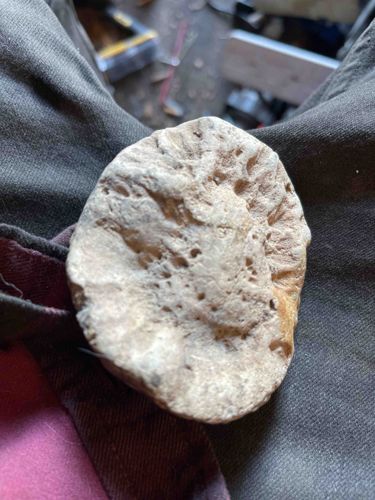
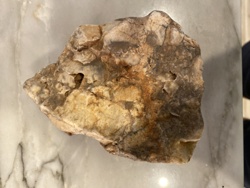
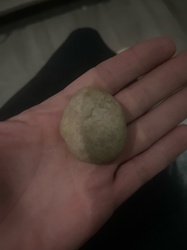
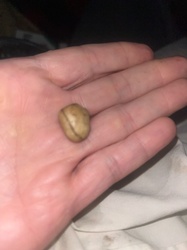
The item is a roughly oval-shaped rock, appearing to be a natural geode or piece of coral. Its primary color is a light, sandy beige or off-white, with some areas exhibiting a subtle brown or orange tint, suggesting mineral staining or natural variations in the stone's composition. The surface is highly textured and irregular, characterized by numerous small, circular to oval depressions and perforations, giving it a porous or spongy appearance. These formations suggest either natural erosion patterns typical of certain rock types like coral or limestone, or the remnants of dissolved crystals, as found in geodes. The rock feels dense and appears solid, without any visible cracks or recent breaks. Its edges are rounded and smoothed, indicating significant weathering or tumbling, possibly in water. There are no discernible markings, inscriptions, or signs of human modification, suggesting it is an unmodified natural specimen. The visible condition is consistent with natural formation and exposure to elements, presenting a natural patina. Its size appears to be small to medium, likely fitting in the palm of a hand. The quality of its features is indicative of a well-preserved natural formation, showing intricate surface details.
AI Appraisal Report
I have thoroughly examined the provided image of what appears to be a weathered geode fragment or porous rock. Based on my visual assessment, the item presents as a natural specimen, likely a piece of highly weathered coral or a tufa formation, given its distinctive porous and textured surface. The rounded edges and overall smooth contours suggest significant natural tumbling or erosion. Its condition appears stable, with no visible breaks or recent damage, consistent with natural geological processes and prolonged exposure to elements. Authenticity, based solely on this image, strongly points to a natural origin; there are no indications of artificial modification.
In terms of market conditions, this type of natural specimen falls under the 'decorative natural history' or 'curiosity' categories. Comparables would include unique geological finds, petrified wood, or abstract natural sculptures sold at specialty rock and mineral shows, online marketplaces for natural items, or even some contemporary home decor outlets that feature organic forms. Demand for such items is niche but consistent among collectors of natural curiosities, geological enthusiasts, and those seeking unique decorative pieces. Its rarity is moderate; while porous rocks are common, one with such intricate and aesthetically pleasing formations, along with its apparent density and size, elevates its appeal.
Factors significantly impacting its value include its intriguing natural sculpture-like form, its well-preserved textured surface, and its apparent solidity. However, without a definitive identification of the rock type (e.g., agate geode, specific coral, or tufa), its marketability is somewhat constrained. Limitations in authenticity verification from images alone are significant. While it strongly appears natural, I cannot definitively rule out highly skilled artistic creation or modification without physical inspection. For full authentication and to ascertain its precise geological origin, in-person examination by a paleontologist or geologist is crucial. This would involve tactile assessment, density checks, and potentially microscopic analysis or dissolution tests.