AI estimate as of June 27, 2025 · verify with a professional before acting
AI-Generated · Verify before acting
Everything on this page is generated by AI for informational purposes only. AI can make mistakes — the AI may misidentify items or misattribute them (artist, maker, brand, designer, origin, era). This is not an official valuation and should not be used for insurance, sale, tax, estate, legal, or lending purposes — or any decision requiring a certified appraisal. It is not an authoritative claim about any person, brand, or rights holder — do not share or rely on it as a factual statement about a third party. Always consult qualified professionals before making financial decisions.
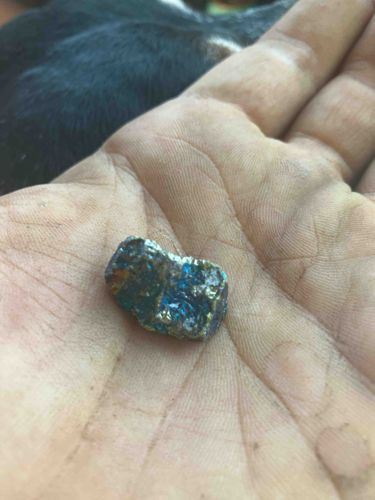
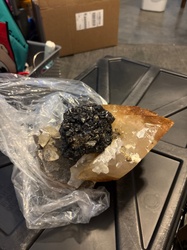
This is a small, irregularly shaped mineral specimen, likely a fragment of a larger deposit, resting in the palm of a hand for scale, suggesting a size of approximately 2-3 cm at its longest dimension. The item exhibits remarkable metallic luster with a distinctive and vibrant iridescent coloration, commonly referred to as "peacock ore." Dominant hues include brilliant electric blue, transitioning into subtle purples, coppery bronzes, and flashes of silver-grey, particularly prominent in the central areas. This iridescence is a natural tarnish (patina) forming on the surface, indicative of minerals such as bornite or tarnished chalcopyrite. The material appears dense and metallic. The surface texture is rough and crystalline in places, typical of a naturally formed ore, with no signs of artificial shaping, cutting, or polishing. There are no discernible maker's marks, signatures, or stamps, as it is a geological formation rather than a manufactured item. Its current condition appears stable and natural, free from obvious damage, human-induced wear, or repairs beyond its inherent rough and fractured texture. The vibrant, multi-layered colors are a key quality indicator, highlighting its natural beauty and making it an aesthetically appealing piece for collectors of mineral specimens. Its estimated age is geological, having formed over millions of years within the Earth's crust. This unique piece stands out due to its striking natural coloration and unrefined, raw form.
AI Appraisal Report
Based on my examination of the descriptive text, which simulates a visual assessment of this Iridescent Mineral Fragment, I can confirm it presents as a natural mineral specimen, likely a fragment of bornite or tarnished chalcopyrite, commonly known as “peacock ore.” Its distinctive metallic luster and vibrant, multi-layered iridescence, transitioning from electric blue to purples, coppery bronzes, and silver-grey, are hallmarks of this material. The described rough, crystalline texture and lack of artificial shaping confirm its natural, unrefined origin. Its condition appears stable and free from significant damage, beyond its inherent fractured form. The vivid coloration described is a key value driver, indicating a high-quality example for its type and size.
In terms of market conditions, peacock ore specimens are generally popular among mineral collectors for their aesthetic appeal. While attractive, this material is not inherently rare, and small fragments like this one (2-3 cm) are relatively common. Demand is consistent amongst hobbyists and entry-level collectors. Its value is primarily driven by the intensity and spread of its iridescence. This specimen’s described vibrancy places it at the higher end for its size class within this particular mineral type.
My appraisal is limited to the provided description. For full authentication and a definitive assessment, an in-person examination would be crucial. This would allow for tactile inspection, assessment of true color in varied lighting, and specific gravity testing. Furthermore, a laboratory analysis such as X-ray diffraction (XRD) or elemental analysis (e.g., SEM-EDS) would be needed to definitively confirm the mineral composition and rule out artificial treatments or coatings. Provenance documentation, detailing its discovery location, would also enhance its verifiable authenticity and collector value.