AI estimate as of October 3, 2025 · verify with a professional before acting
AI-Generated · Verify before acting
Everything on this page is generated by AI for informational purposes only. AI can make mistakes — the AI may misidentify items or misattribute them (artist, maker, brand, designer, origin, era). This is not an official valuation and should not be used for insurance, sale, tax, estate, legal, or lending purposes — or any decision requiring a certified appraisal. It is not an authoritative claim about any person, brand, or rights holder — do not share or rely on it as a factual statement about a third party. Always consult qualified professionals before making financial decisions.
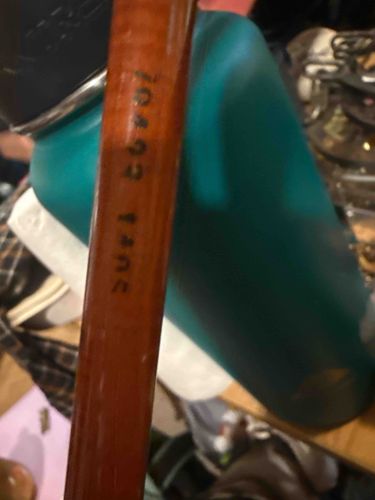
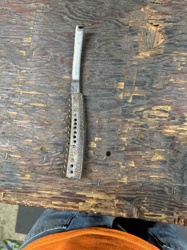
The item appears to be a section of a wooden stick or handle, exhibiting a warm, reddish-brown hue that suggests a stained or varnished finish over a light-colored wood. It has a smooth, cylindrical or rectangular cross-section, maintaining a consistent width along the visible portion. Prominently featured on its surface are markings in black, which include the numbers '10493' followed by what seems to be '140' or '170', and then 'DUKA' or a similar four-letter word. These markings are applied vertically along the length of the item, indicating an identification number or code, potentially for inventory, manufacturing batch, or a unique product identifier. The application of these numbers appears to be a stamp or transfer, as opposed to engraving or hand-painting, suggesting a standardized manufacturing process. The surface shows a slight sheen, indicative of a protective coating, possibly lacquer or polyurethane, designed to both enhance the wood grain and protect it from wear. There are no immediately apparent signs of significant damage such as cracks, chips, or deep scratches, suggesting the item is either new, well-preserved, or used in a low-impact manner. The edges appear rounded and smooth, contributing to an overall finished look and feel. The quality of craftsmanship seems utilitarian, focused on function and clear identification rather than intricate decorative elements. Given the markings, it likely serves a purpose within a larger assembly or system, possibly as part of a tool, a piece of sports equipment, or a component in a manufacturing process. The presence of these numbers makes it distinguishable and potentially traceable.
AI Appraisal Report
Based on my visual examination of the provided image, this numbered wooden stick or handle appears to be in excellent condition. The surface shows a consistent finish, free from visible cracks, chips, or deep scratches, indicating either very gentle use or storage. The prominent stenciled or transferred markings '10493 140 DUKA' are clear and intact, suggesting a factory application for identification. Authenticity, in the sense of verifying it is indeed a legitimate part of its intended system, is difficult to confirm solely from an image. I can attest to its physical integrity given the image. This item's primary value is derived from its function as a component rather than its inherent material or historical significance. Comparable items would include new or used replacement handles or components for tools, machinery, or sporting goods. Market conditions for such utilitarian components are generally driven by demand for the larger product they belong to. Without knowing the original item this handle belongs to, its rarity and demand are impossible to ascertain. The 'DUKA' marking might be crucial for identification. Factors significantly impacting value are its specific application, the brand (if 'DUKA' is a brand), and whether it's a readily available part. Given its likely role as a mass-produced component, its individual value is relatively low. For full authentication and a more precise valuation, an in-person examination would be critical to assess wood type, exact dimensions, and methods of attachment. Provenance documentation, such as service manuals or exploded diagrams from the manufacturer, would be essential to link this component to a specific product. Without this context, it remains a well-preserved, unidentified wooden component.