AI Appraisal Estimate

AI-generated estimates · not official valuations

From the user

What was submitted

Photo and notes provided by the user — not generated by AI

Submitted item photo
Submitted photo · June 13, 2026

User's notes

No additional notes provided.

AI analysis below

AI appraisal

AI analysis & estimate

AI-Generated · Verify before acting

Everything below is generated by AI for informational purposes only. AI can make mistakes — the AI may misidentify items or misattribute them (artist, maker, brand, designer, origin, era). This is not an official valuation and should not be used for insurance, sale, tax, estate, legal, or lending purposes — or any decision requiring a certified appraisal. It is not an authoritative claim about any person, brand, or rights holder — do not share or rely on it as a factual statement about a third party. Always consult qualified professionals before making financial decisions.

Read the full disclaimer

AI Identification

·Not independently authenticated·Verify before acting

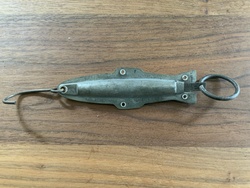
Carved Bone Knife or Tool Handle

Antiques & Collectibles / Tools & Hardware

AI Estimated Value

·Not an official valuation·Verify before acting

$45.00 - $75.00

As of June 13, 2026

AI Item Analysis

·AI can make mistakes·Verify before acting
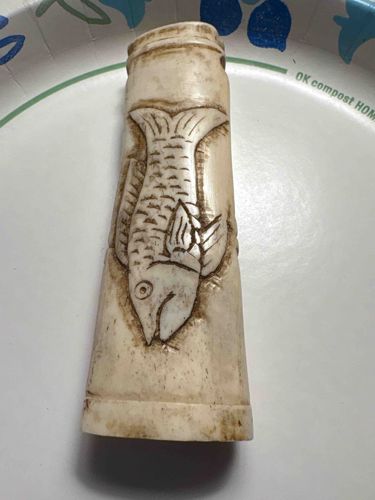
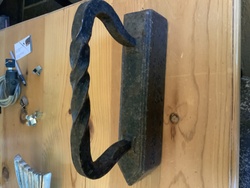
This object is a tapered, cylindrical handle, presumably intended for a knife, letter opener, or similar small hand tool. It is crafted from a natural organic material, most likely bovine bone, given the visible porous texture and lack of Schreger lines associated with ivory. The central decorative feature is an incised relief carving of a fish, oriented vertically with its head facing downward. The carving style is folk-art influenced, utilizing simple hatched lines for scales and fins. The material possesses a natural off-white to cream coloration with significant dark brown staining concentrated in the recessed carved areas and along the base. The surface displays a matte finish with visible pitting and small dark flecks characteristic of organic bone structure. The object features a slightly flared base and a finished, rounded pommel end with a narrow horizontal groove. In terms of condition, the piece shows moderate surface wear, consistent with age and handling. There are small chips and abrasions visible near the bottom edge. The dark patina in the carvings may be intentional to provide contrast or the result of accumulated grime. While no maker's marks are visible, the craftsmanship suggests a late 20th-century decorative or ethnographic accessory, possibly originating from a regional souvenir trade or a hobbyist carver.
AI Appraisal Report

·AI can make mistakes·Verify before acting
I have conducted a visual examination of the carved handle, which appears to be a functional or decorative object crafted from bovine bone. The piece features a stylized fish in relief, utilizing a folk-art aesthetic with simple cross-hatching. Based on the visible pores (the Haversian system) and the absence of the diamond-patterned Schreger lines, I have definitively ruled out elephant ivory. The dark staining in the recesses is characteristic of an applied antiquing wash or accumulated organic matter from handling rather than high-end scrimshaw techniques. In terms of condition, I observed moderate wear, including pitting and minor abrasions at the base, which are consistent with a late 20th-century origin. The craftsmanship suggests a regional souvenir or a hobbyist production rather than a master artisan's work. The market for such items is currently modest; comparable ethnographic or folk-art bone handles of no specific lineage typically sell within the $30 to $100 range at auction or through antique collectives. Rarity is low, as these items were produced in significant quantities for the giftware and hobbyist markets between 1970 and 1990. Several limitations exist with this remote appraisal: I cannot verify the exact species of bone without DNA testing or microscopic cross-section analysis. A physical inspection would be required to determine if the dark patina is chemically applied or natural oxidation. Furthermore, without provenance documentation linking the piece to a known carver or specific historical site, the value is based strictly on its decorative appeal. To increase the certainty of this valuation, I would recommend an in-person assessment to check for structural cracks not visible in photos.

Get your items appraised

Instant estimates of your treasures with AI-powered appraisals

Browse More Appraisals