These notes were written by the person who submitted this item. Appraiser.AI has not verified them, and the AI's identification and estimate may rely on them.
AI Estimated Value
Not an official valuation
$400-600
AI estimate as of August 2, 2025 · verify with a professional before acting
AI-Generated · Verify before acting
Everything on this page is generated by AI for informational purposes only. AI can make mistakes — the AI may misidentify items or misattribute them (artist, maker, brand, designer, origin, era). This is not an official valuation and should not be used for insurance, sale, tax, estate, legal, or lending purposes — or any decision requiring a certified appraisal. It is not an authoritative claim about any person, brand, or rights holder — do not share or rely on it as a factual statement about a third party. Always consult qualified professionals before making financial decisions.
This analysis also relies on unverified notes provided by the user, which may be incomplete or inaccurate and could affect the result.
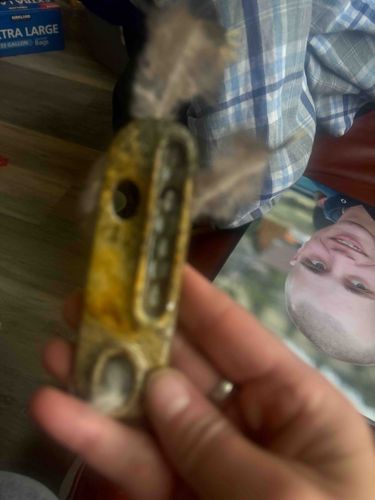
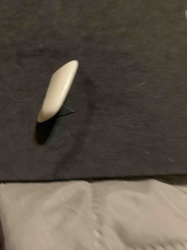
The item appears to be a carved antler, horn, or bone tool handle, possibly for an ulu or another type of knife or scraper, exhibiting characteristics common to Alaskan Native craftsmanship. Its overall shape is elongated and rectangular with rounded ends, suggesting ergonomic gripping. The material displays a variegated yellowish-brown coloration, indicative of natural bone, antler, or horn, with areas of darker staining or patina, especially within recessed areas, suggesting age and handling. There are two distinct openings: one is a large, circular, drilled hole located towards one end, likely intended for a thong or lanyard for carrying or securing the tool. The other end features a broader, more oval-shaped indentation or socket, possibly designed to receive a blade or another implement. The surface texture appears somewhat worn but also retains some natural irregularities of the material. There are visible striations or grain patterns intrinsic to the organic material. Within the elongated central channel or groove, there appear to be a series of smaller, possibly decorative or functional, indentations or divisions. The finish is not polished to a high sheen, suggesting a focus on utility and natural aesthetics. The signs of wear and the aged patina contribute to its appearance as an authentic, potentially older, piece. The craftsmanship, though not overly elaborate, highlights functional design with an appreciation for the natural form and texture of the material. No discernible maker's marks or signatures are visible in the provided image. Its style is consistent with traditional utilitarian objects created by Indigenous peoples of Alaska, often serving practical purposes within daily life or subsistence activities, dating potentially from the early to mid-20th century or even earlier, given the wear.
AI Appraisal Report
Based on my visual examination of the provided image, this Alaskan carved antler/bone tool handle presents as an authentic piece of Indigenous craftsmanship. The variegated yellowish-brown coloration, natural grain patterns, and the significant aged patina, particularly within recessed areas, strongly suggest a utilitarian object with considerable age and use. The wear on the surface and the practical design, including the lanyard hole and blade socket, are consistent with traditional Alaskan Native tools. Its condition appears stable, with no obvious cracks or structural damage visible, though typical wear from prolonged handling is evident and expected for such an item. \n\nThe market for authentic Indigenous Alaskan artifacts, particularly functional tools, remains consistent, driven by collectors interested in ethnography, history, and Native American art. Comparable items, especially those with good patination and clear signs of use, have shown steady demand. The rarity of well-preserved, utilitarian pieces like this is moderate; while not unique, those with undeniable age and character are less common than more modern decorative pieces. \n\nFactors positively impacting value include the clear signs of age and use, the presumed authenticity, and its representation of traditional Alaskan Native material culture. The absence of maker's marks is typical for such historical utilitarian objects.\n\nLimitations in authenticity verification from an image alone are significant. While it presents very well, a definitive authentication would require in-person examination to assess the material's precise composition, to confirm the patina is natural aging rather than artificial, and to feel the surface texture. Microscopic analysis could confirm tool marks and age. Provenance documentation, such as the history of ownership or collection details, would provide invaluable context and strengthen its authenticity claim. Scientific testing, like carbon-14 dating if the material permits, could provide a more precise age determination, further impacting its value.