AI estimate as of December 14, 2025 · verify with a professional before acting
AI-Generated · Verify before acting
Everything on this page is generated by AI for informational purposes only. AI can make mistakes — the AI may misidentify items or misattribute them (artist, maker, brand, designer, origin, era). This is not an official valuation and should not be used for insurance, sale, tax, estate, legal, or lending purposes — or any decision requiring a certified appraisal. It is not an authoritative claim about any person, brand, or rights holder — do not share or rely on it as a factual statement about a third party. Always consult qualified professionals before making financial decisions.
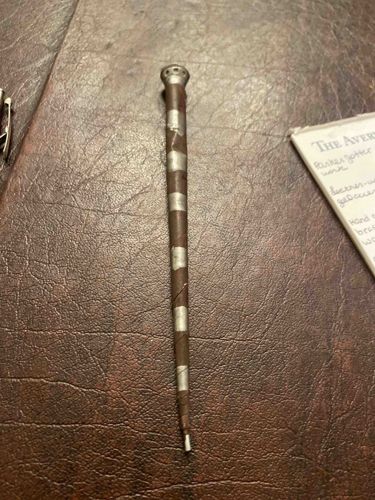
This item appears to be a vintage pin vise or a handle for a small precision tool, likely used in watchmaking, jewelry making, or other delicate crafts. It is elongated and tapered, with an overall dark brown coloration and interspersed with regularly spaced, horizontal bands of what appears to be bare metal, possibly silver, aluminum, or a similar light-colored alloy. These bands create a striped, segmented appearance along the shaft of the tool. The construction suggests a core shaft wrapped or inlaid with contrasting materials. The top end features a rounded, wider cap with several small, evenly spaced indentations or holes, likely providing grip and a textured surface for the thumb or palm during use. The shaft gradually tapers to a fine point at the opposite end. Given its likely function, the materials would need to be sturdy, possibly steel for the core, with the external decorative or functional elements being a contrasting metal or dark-finished wood/composite. The visible condition shows age-related wear, including some scratching on the dark material and possibly some darkening or tarnishing on the lighter metal bands, indicating a natural patina. The tip also appears slightly bent or worn, suggesting past usage. There are no discernible manufacturer's marks, signatures, or stamps visible in the image. Based on its style and apparent construction, it could date from the late 19th to mid-20th century, a period when such specialized hand tools were common. The craftsmanship appears functional and precise, typical of tools used for fine detail work, providing a secure grip for delicate operations.
AI Appraisal Report
Upon visual examination of this vintage pin vise or small tool handle, I assess its condition as good, displaying signs of age and use consistent with its likely purpose. The dark brown material shows minor scratches, while the lighter metal bands exhibit some darkening or tarnishing, indicating a natural patina. The slightly bent or worn tip further confirms its history of usage. Authenticity is suggested by the apparent craftsmanship and materials, typical of precision tools from the late 19th to mid-20th century. However, without physical inspection, I cannot confirm the exact composition of the materials or definitively rule out modern reproduction.
In terms of market conditions, vintage precision hand tools, while not highly sought after by mainstream collectors, do have a segment of enthusiasts, including watchmakers, jewelers, and hobbyists. Comparable items, often sold as part of larger tool sets or individually, typically fetch modest prices. Demand for a single, unmarked pin vise is generally low, limiting its rarity despite its age. Factors impacting value include the absence of manufacturer's marks, which would significantly increase its appeal, and the apparent wear. Its primary value lies in its historical and functional utility rather than as a decorative antique. While it is a well-preserved example, it doesn't possess unique characteristics that would command a premium.
It is crucial to note that my assessment is limited to what can be gleamed from the provided image. For full authentication and a more precise valuation, an in-person examination would be necessary. This would allow for detailed inspection of material composition, the presence of any hidden marks, and an assessment of the tool's balance and functionality. Scientific testing of the metals could conclusively determine their type, and provenance documentation, if available, would significantly enhance its value and confirm its historical context.