AI estimate as of September 27, 2025 · verify with a professional before acting
AI-Generated · Verify before acting
Everything on this page is generated by AI for informational purposes only. AI can make mistakes — the AI may misidentify items or misattribute them (artist, maker, brand, designer, origin, era). This is not an official valuation and should not be used for insurance, sale, tax, estate, legal, or lending purposes — or any decision requiring a certified appraisal. It is not an authoritative claim about any person, brand, or rights holder — do not share or rely on it as a factual statement about a third party. Always consult qualified professionals before making financial decisions.
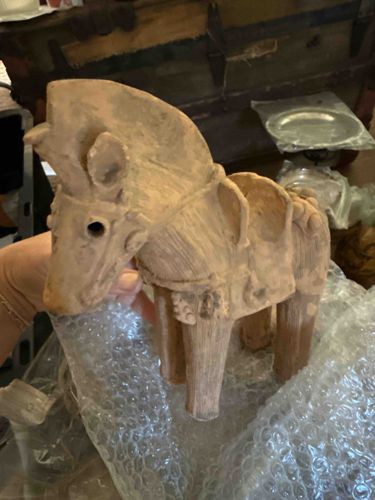
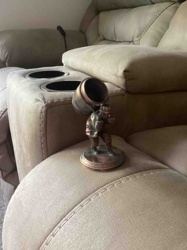
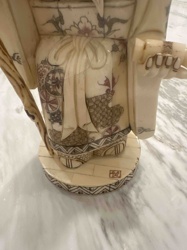
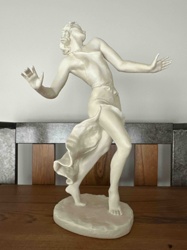
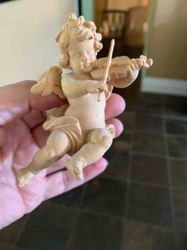
The item is a terracotta figure of a horse, appearing to be an ancient or ancient-style artifact, possibly a burial or ritualistic offering figure. It is carved from a reddish-brown earthenware clay that has a matte, unglazed finish, consistent with traditional terracotta. The color is a natural, earthy reddish-brown with variations in tone, suggesting either natural clay differences or age-related patina. The horse is depicted in a stylized, somewhat abstract manner, typical of ancient figurines, rather than a lifelike representation. It has a robust, blocky body with four thick, cylindrical legs that stand firmly. The head features prominent ears, a discernible muzzle, and a single drilled or punched hole for an eye, indicating a rudimentary yet expressive facial rendering. There are sculpted details suggesting a bridle or harness around the head and neck, and possibly saddle or blanket drapery over its back. These details are indicated by raised bands and textured surfaces, though they are not intricately carved. The overall construction displays hand-molding and sculpting techniques. There are visible signs of age and wear, including surface abrasions, minor chipping, and a dusty or layered patina that suggests prior exposure or burial. No distinct manufacturing marks, signatures, or stamps are visible in the provided image. The style and construction suggest it could be a reproduction of an ancient artifact, perhaps Tang Dynasty or similar historical periods known for such horse figures, or an actual ancient piece, though further analysis would be needed to confirm authenticity and precise dating. The craftsmanship, while not highly refined in intricate detail, shows a robust and deliberate form, indicative of its original purpose, whether decorative or ceremonial. Its compact and sturdy form indicates it was likely intended to be a standalone, enduring object.
AI Appraisal Report
Upon visual examination of this terracotta horse figure, I observe a charming, stylized depiction, strongly reminiscent of ancient funerary or ritualistic art, particularly those from the Tang Dynasty. The reddish-brown earthenware clay, matte unglazed finish, and robust, blocky construction are consistent with such pieces. The rudimentary facial features, drilled eye, and suggested bridle/saddle details through raised bands are characteristic of hand-molding techniques from historical periods. The visible surface abrasions, minor chipping, and layered patina suggest age and prior exposure, potentially to burial conditions.
Assessing authenticity purely from images presents significant limitations. While the style is convincing, without in-person examination, I cannot definitively confirm its age. Authenticity verification would require physical inspection to assess the clay body, mineral deposits, and construction techniques more closely. Thermoluminescence (TL) dating would be essential to determine its actual production age, and thorough provenance documentation (history of ownership) would provide crucial historical context.
In terms of market conditions, ancient-style terracotta horse figures, especially genuine antiquities, fetch substantial prices. However, high-quality reproductions, often aged to look authentic, are also prevalent. If this piece proves to be a genuine ancient artifact, its value would be significantly higher. Given the current visual evidence, and acknowledging the possibility of it being a well-made reproduction, I am appraising it within a range suitable for an attractive decorative antiquity-style piece. The demand for such folk-art inspired figures is steady, particularly for those presenting a convincing aged aesthetic. Its sturdy form and decorative appeal contribute positively to its marketability.
Without further authentication, the value is primarily driven by its aesthetic appeal as an antique-style art object. Should scientific testing prove it to be a genuine ancient artifact, the value would increase substantially, potentially into the thousands. For now, based solely on visual attributes, I assign an appraisal value of $600-900.