AI Appraisal Estimate

AI-generated estimates · not official valuations

From the user

What was submitted

Photo and notes provided by the user — not generated by AI

Submitted item photo
Submitted photo · June 25, 2026

User's notes

No additional notes provided.

AI analysis below

AI appraisal

AI analysis & estimate

AI-Generated · Verify before acting

Everything below is generated by AI for informational purposes only. AI can make mistakes — the AI may misidentify items or misattribute them (artist, maker, brand, designer, origin, era). This is not an official valuation and should not be used for insurance, sale, tax, estate, legal, or lending purposes — or any decision requiring a certified appraisal. It is not an authoritative claim about any person, brand, or rights holder — do not share or rely on it as a factual statement about a third party. Always consult qualified professionals before making financial decisions.

Read the full disclaimer

AI Identification

·Not independently authenticated·Verify before acting

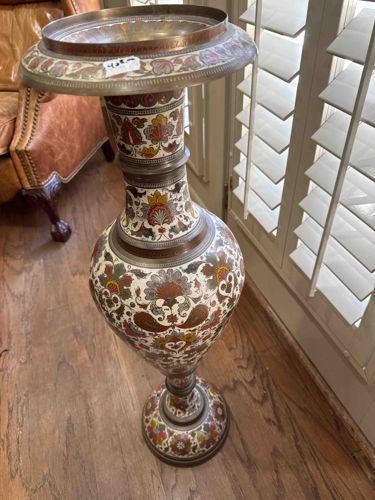
Persian Isfahan Ghalamzani and Enamel Tall Metal Floor Vase

Decorative Arts/Middle Eastern Antiques

AI Estimated Value

·Not an official valuation·Verify before acting

$400 - $600

As of June 25, 2026

AI Item Analysis

·AI can make mistakes·Verify before acting
This is a significant, floor-standing decorative metal vase, likely originating from Persia (modern-day Iran) in the mid-to-late 20th century. It stands at a substantial height and is constructed from what appears to be brass or tinned copper. The item features an elaborate decorative technique known as Ghalamzani, involving hand-tooled engraving into the metal surface, which is then accented with a colorful Champlevé enamel filling. The color palette consists of classic Persian hues including burnt orange, deep reds, mustard yellows, and whites, set against the darkened metallic base. The patterns are predominantly floral and foliate, featuring stylized petal motifs and scrollwork that wrap around the vessel's multi-tiered body, flared neck, and circular stepped base. Notably, it features a wide, flat rim at the top, which might allow it to function as a plant pedestal or a large incense burner holder. Regarding condition, there is visible surface wear consistent with age, including areas of tarnish and darkening (patina) on the exposed metal sections, particularly around the rims and joints. Some of the enameled areas show minor pitting or fading, but the overall structural integrity seems sound. There is a price tag affixed to the upper rim suggesting it has been through a secondary market or estate sale. The craftsmanship displays high complexity, indicating a skilled artisan piece typical of the Isfahan region's tradition.
AI Appraisal Report

·AI can make mistakes·Verify before acting
Based on a visual examination, this is a distinct example of mid-to-late 20th-century Persian metalwork, likely crafted in Isfahan. The vase typifies the synthesis of Ghalamzani (metal engraving) and enamel work found in decorative export wares of the Pahlavi era. The intricate foliate patterns and specific color palette—burnt orange, azure, and cream—are hallmarks of this regional style. The structural integrity appears sound, though the piece shows significant patina and tarnish consistent with age, particularly on the brass substrate. There is minor loss to the enamel in high-relief areas, which moderately impacts value but is expected for floor-standing pieces. The market for mid-century Persian decorative metalwork is currently stable but selective. While collectors seek earlier Qajar dynasty pieces for investment, items like this fall into the 'decorative furnishing' category. Its large scale is a positive factor, as floor vases command higher prices than tabletop items. However, the observable surface wear and the nature of the craftsmanship suggest this was likely produced in a workshop setting rather than by a master signatory artist. Limitations of this digital appraisal are significant. Without physical inspection, I cannot confirm the base metal composition (whether solid brass or tinned copper) or check for a maker's mark (often hidden on the base), which is crucial for determining specific workshop provenance. Authentic 19th-century examples command significantly higher prices; however, the bright hue of the enamel and the stylistic execution strongly suggest a vintage 20th-century date. Consequently, the appraisal value reflects its status as a high-quality decorative object rather than a rare antiquity.

Get your items appraised

Instant estimates of your treasures with AI-powered appraisals

Browse More Appraisals