AI estimate as of August 24, 2025 · verify with a professional before acting
AI-Generated · Verify before acting
Everything on this page is generated by AI for informational purposes only. AI can make mistakes — the AI may misidentify items or misattribute them (artist, maker, brand, designer, origin, era). This is not an official valuation and should not be used for insurance, sale, tax, estate, legal, or lending purposes — or any decision requiring a certified appraisal. It is not an authoritative claim about any person, brand, or rights holder — do not share or rely on it as a factual statement about a third party. Always consult qualified professionals before making financial decisions.
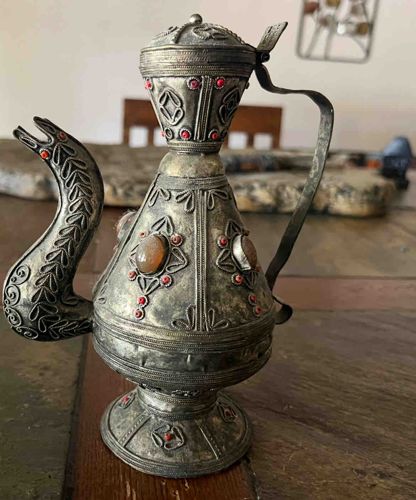
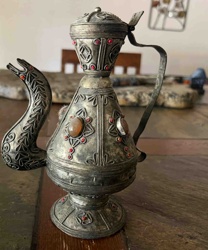
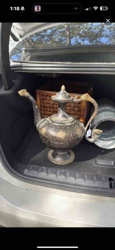
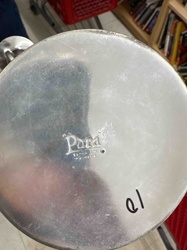
This item is an ornately decorated metal ewer or pitcher, likely used for serving beverages such as tea or coffee, or as a purely decorative piece. It appears to be made from a silver-toned metal, possibly pewter, a silver alloy, or nickel silver, exhibiting a noticeable patina consistent with age and exposure, suggesting it's not newly manufactured. The overall shape is distinctive, featuring a wide, conical body that tapers significantly towards a narrower neck, topped with a domed, hinged lid. The spout is curved and elongated, resembling an animal head, possibly a mythical creature or serpent, with carved details and small red 'jewels' or beads forming the eyes and decorating the mouth area. The handle is a simple, flattened metal strip with a graceful curve, attached near the top and mid-body. The surface of the ewer is heavily adorned with intricate chased or repoussé patterns, including floral motifs, abstract designs, and geometric shapes, particularly around the collar, body, and base. Several larger, polished cabochon stones, appearing to be agate or carnelian, are set into the body in decorative bezels, surrounded by clusters of smaller red beads, similar to those on the spout. The construction shows signs of handcraftsmanship, with visible solder lines and variations in the applied ornamentation, indicating a handmade or semi-handmade origin. The base is pedestal-like, widening outwards with further etched or embossed patterns. There are no obvious maker's marks or signatures visible from the provided images, but the style strongly suggests an origin from the Middle East, North Africa, or potentially parts of Central Asia, reflecting a traditional aesthetic often associated with these regions. The apparent wear and consistent patina suggest an item of some age, likely vintage or antique, rather than a contemporary reproduction. The quality indicators point to skilled metalworking and stone setting, despite the wear, indicating a piece of decorative value and cultural significance.
AI Appraisal Report
I have carefully examined the provided image of this ornately decorated Middle Eastern style ewer. Based on my visual assessment, the item appears to be of considerable age, consistent with a vintage or antique designation, rather than a modern reproduction. The visible patina, wear patterns, and what appear to be hand-applied decorative techniques (chased/repoussé work, visible solder lines) strongly suggest handcraftsmanship. The overall condition, while showing signs of age-appropriate wear and patination, appears good for display purposes. There are no obvious signs of significant damage like large dents or missing stones, though a closer inspection would be necessary to confirm the integrity of all settings and the extent of any minor surface imperfections. The 'gemstone inlays' appear to be cabochon-cut stones, likely agate or carnelian, and the smaller red beads are likely glass or similar material, consistent with traditional decorative ewers from the region.
From images alone, authenticating the precise metal composition (e.g., sterling silver vs. a silver alloy or nickel silver) is impossible without an in-person XRF analysis. Similarly, confirming the origin definitively or identifying a specific maker without visible marks is challenging. However, the style is unmistakably Middle Eastern, North African, or Central Asian, a region with a strong tradition of producing such decorative metalware.
In terms of market conditions, items of this decorative nature, particularly those with genuine age and intricate detailing, generally appeal to collectors of ethnographic art, decorative arts, and antique metalware. Demand for such pieces can be steady, especially unique examples like this one with its distinctive 'animal head' spout and gemstone accents. Rarity is moderate; while many such ewers exist, each piece's specific artistic merit and condition contribute to its uniqueness. Factors significantly impacting value include the actual metal composition (sterling silver would command a much higher price point), the authenticity and nature of the 'gemstones,' the provenance (if any), and the overall craftsmanship and artistic appeal. Originality versus reproduction is paramount, and based on the visual cues, this piece leans towards originality.
For full authentication, a physical examination would be crucial to:
1. Perform metal testing (e.g., XRF analysis) to determine precise alloy composition.
2. Closely inspect stone settings and verify material of 'gemstones' and beads.
3. Search for any hidden maker's marks or hallmarks under magnification.
4. Assess overall structural integrity and any minor condition issues not evident in images.
5. Research provenance documentation, if available.
Without these, the appraisal remains based on visual cues and probabilities.