AI estimate as of September 18, 2025 · verify with a professional before acting
AI-Generated · Verify before acting
Everything on this page is generated by AI for informational purposes only. AI can make mistakes — the AI may misidentify items or misattribute them (artist, maker, brand, designer, origin, era). This is not an official valuation and should not be used for insurance, sale, tax, estate, legal, or lending purposes — or any decision requiring a certified appraisal. It is not an authoritative claim about any person, brand, or rights holder — do not share or rely on it as a factual statement about a third party. Always consult qualified professionals before making financial decisions.
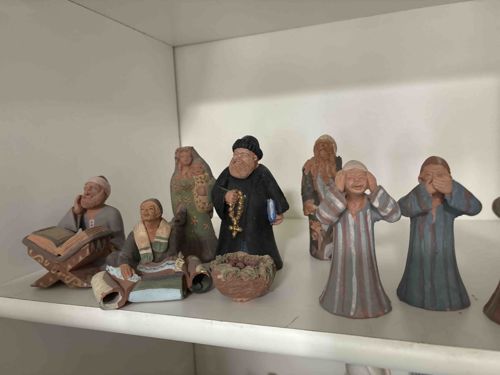
This is a collection of approximately ten figural statuettes, depicting individuals in traditional Middle Eastern attire and poses. The figures appear to be made from a ceramic or terracotta material, possibly hand-painted, given the slight variations and rustic finish. They exhibit a matte to slightly satin finish, suggesting either unglazed pottery or a low-sheen glaze. The color palette is earthy and subdued, featuring shades of brown, grey, blue, green, and black, with accents of off-white and hints of gold/yellow, particularly on details like the rosary and book.
Observable details include a figure seated at a wooden book stand holding an open book (possibly the Quran), a seated man with a scarf and what appears to be jugs next to him, a standing female figure in a patterned green dress, and a prominent male figure with a dark robe, black head covering, and a distinctive long beard, holding a golden rosary and a dark book. Further to the right, there are figures depicting the 'see no evil, hear no evil' motif, with one covering his ears and another covering his eyes, wearing striped and solid robes respectively. Another figure appears to have a long, flowing beard and is cloaked. The craftsmanship suggests these are artisan-made, possibly originating from a regional craft tradition. The details, such as facial expressions and clothing patterns, are rendered with a moderate level of intricacy, indicating a balance between realistic representation and stylized folk art. The overall condition appears good with no obvious chips or cracks visible from the provided image, though minor surface wear or dust is present. The figures are distinct in their individual characterizations but form a cohesive set, likely representing various aspects of daily life or religious figures in the Middle East. Their size appears to be consistent, likely ranging from 4 to 8 inches in height, suitable for display on a shelf.
AI Appraisal Report
Based on my visual examination of the provided image, I assess this collection of approximately ten Middle Eastern themed figural statuettes. The figures appear to be crafted from ceramic or terracotta, likely hand-painted given the subtle variations in finish and detail. The overall condition seems good, with no obvious chips or cracks visible, although some minor surface dust is apparent. The matte to slightly satin finish suggests either unglazed pottery or a low-sheen glaze, consistent with artisan-made pieces.
From a market perspective, these type of ethnic or folk art statuettes generally appeal to niche collectors interested in cultural artifacts or decorative items. Comparables often found in online marketplaces or specialty antique/collectible shops suggest a moderate value. While the craftsmanship is good, indicating a balance between realism and folk art stylization, these are not high-end fine art pieces. Their cohesive nature as a set enhances their appeal and value compared to individual pieces.
Demand for such collections is steady but not exceptionally high, and rarity is moderate; similar items can be found, but a complete, well-preserved set like this is less common. Factors impacting value include the artisan quality, the good condition, and the thematic unity. The lack of identifiable maker's marks or provenance limits the upper end of the valuation.
It is important to note the limitations of authenticating solely from images. A definitive authenticity verification would require in-person examination to ascertain the exact material composition, inspect for repairs or restorations, and look for any hidden maker's marks. Physical handling would also allow for a more precise assessment of craftsmanship and age. Provenance documentation, if available, would significantly impact and potentially increase the value by establishing origin, age, and maker.