Collection of Mid-20th Century European Banknotes
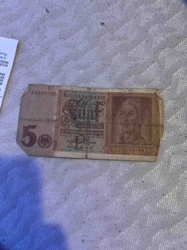
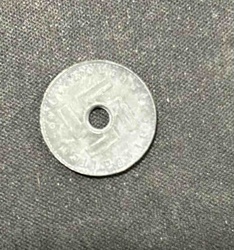
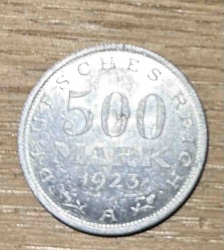
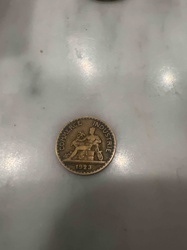
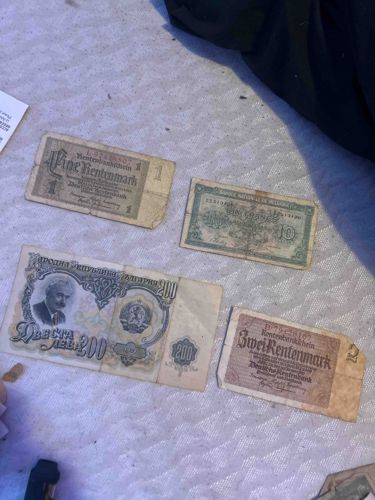
This collection consists of four distinct historical banknotes from Europe, featuring a 200 Leva note from the People's Republic of Bulgaria (dated 1951), a 10 Francs note from the National Bank of Belgium, and two German Rentenmark notes (a 1 Rentenmark and a 2 Rentenmark). The Bulgarian note is the largest, featuring a portrait of Georgi Dimitrov and a complex guilloché pattern in shades of blue and tan. The German notes, issued by the Deutsche Rentenbank, feature Fraktur script and various serial numbers in red ink, representing the Weimar Republic's stabilization period. The Belgian 10 Francs note displays a classic green and blue engraved aesthetic. The physical condition of the notes varies from 'fair' to 'poor.' Notable condition issues include significant corner rounding, heavy creasing from circulation, and visible staining or atmospheric foxing across the paper surfaces. The 1 and 2 Rentenmark notes exhibit more severe weathering, with frayed edges and significant discoloration. The printing craftsmanship shows the high-quality intaglio and lithographic techniques of the mid-20th century, including intricate security background patterns and official seals. These items serve as significant numismatic artifacts of post-war and interwar European economic history.
AI-Generated Appraisal Disclaimer
Estimated Value
$15 - $25
Basic Information
Category
Numismatics / Historical Currency
Appraised On
February 1, 2026
Estimated Value
$15 - $25
Item Description
This collection consists of four distinct historical banknotes from Europe, featuring a 200 Leva note from the People's Republic of Bulgaria (dated 1951), a 10 Francs note from the National Bank of Belgium, and two German Rentenmark notes (a 1 Rentenmark and a 2 Rentenmark). The Bulgarian note is the largest, featuring a portrait of Georgi Dimitrov and a complex guilloché pattern in shades of blue and tan. The German notes, issued by the Deutsche Rentenbank, feature Fraktur script and various serial numbers in red ink, representing the Weimar Republic's stabilization period. The Belgian 10 Francs note displays a classic green and blue engraved aesthetic. The physical condition of the notes varies from 'fair' to 'poor.' Notable condition issues include significant corner rounding, heavy creasing from circulation, and visible staining or atmospheric foxing across the paper surfaces. The 1 and 2 Rentenmark notes exhibit more severe weathering, with frayed edges and significant discoloration. The printing craftsmanship shows the high-quality intaglio and lithographic techniques of the mid-20th century, including intricate security background patterns and official seals. These items serve as significant numismatic artifacts of post-war and interwar European economic history.
Related Tags
Get Your Items Appraised
Instant estimates of your treasures with AI-powered instant appraisals