AI Appraisal Estimate

AI-generated estimates · not official valuations

From the user

What was submitted

Photo and notes provided by the user — not generated by AI

Submitted item photo
Submitted photo · June 13, 2026

User's notes

No additional notes provided.

AI analysis below

AI appraisal

AI analysis & estimate

AI-Generated · Verify before acting

Everything below is generated by AI for informational purposes only. AI can make mistakes — the AI may misidentify items or misattribute them (artist, maker, brand, designer, origin, era). This is not an official valuation and should not be used for insurance, sale, tax, estate, legal, or lending purposes — or any decision requiring a certified appraisal. It is not an authoritative claim about any person, brand, or rights holder — do not share or rely on it as a factual statement about a third party. Always consult qualified professionals before making financial decisions.

Read the full disclaimer

AI Identification

·Not independently authenticated·Verify before acting

Senufo Kpelie Mask

African Tribal Art & Collectibles

AI Estimated Value

·Not an official valuation·Verify before acting

$450 - $850

As of June 13, 2026

AI Item Analysis

·AI can make mistakes·Verify before acting
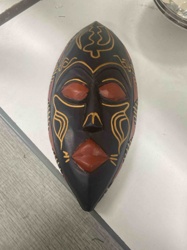
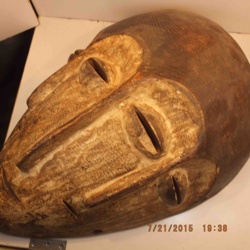
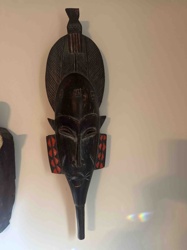
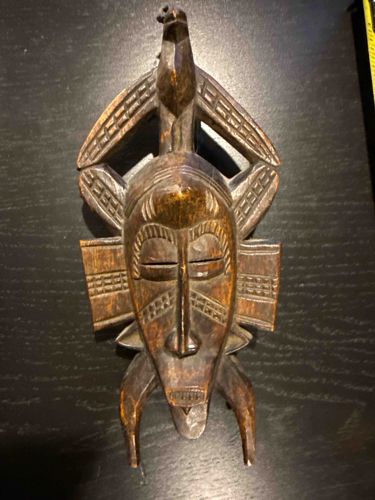
This is a hand-carved West African mask, identified as a Kpelie mask, traditionally created by the Senufo people of Ivory Coast, Mali, and Burkina Faso. The mask is carved from a single block of dense, dark hardwood with a polished brown patina. It features characteristic Senufo aesthetic elements, including an elongated oval face with narrow slit eyes, a long slender nose, and a small protruding mouth. Surrounding the face are various symbolic appendages, including horn-like projections at the top and bottom, and flat rectangular 'ears' or flanges on the sides decorated with geometric incised patterns. A distinct crest, likely a bird or hornbill figure (Senufo symbol of fertility), tops the head. The surface exhibits intricate scarification-style carvings on the forehead and cheeks. In terms of condition, the mask shows evidence of significant age, with multiple surface abrasions, small nicks on the edges of the carved appendages, and an uneven finish that indicates heavy handling and oxidative aging. There are no visible maker's marks or signatures, which is typical for traditional ritual objects. The craftsmanship is of high quality, demonstrating specialized knowledge of anatomical distortion and symbolic abstraction typical of the mid-20th-century artisan tradition intended for ceremonial use or the early African art trade.

AI Appraisal Report

·AI can make mistakes·Verify before acting
I have carefully examined the high-resolution images of this Kpelie mask, attributed to the Senufo people. The mask displays the classical stylistic canon of the 'Kpanjugu' style, notably the bird crest, flange appendages, and distinct geometric scarification. Based on the visual evidence, the piece possesses an authentic aesthetic and shows wear consistent with mid-20th-century artisan production. The dark hardwood patina appears developed, though the nicks and abrasions suggest either light ritual use or, more likely, careful aging for the burgeoning mid-century African art market. The current market for Senufo art is bifurcated; pieces with verified 19th-century provenance and 'encrusted' ritual patinas fetch tens of thousands, while high-quality mid-century decorative or 'trade' pieces—likely where this example falls—range between $400 and $900. The craftsmanship here is superior, particularly the delicate balance of the hornbill crest, which significantly bolsters its desirability. Limitations: Verification of authenticity is strictly limited by the digital format. From images alone, I cannot confirm the depth of the wood's internal oxidation or identify the presence of modern tool marks (such as sandpaper or circular saws) hidden by the patina. To confirm a higher 'ritual' valuation, I would require an in-person macroscopic inspection of the distal surface to check for sweat-and-oil absorption from the dancer's face. Additionally, definitive authentication would require provenance documentation (e.g., collection history prior to 1960) or carbon-14 dating of the wood. Until then, the value reflects its status as a high-quality, mid-20th-century ethnographic collectible.

Get your items appraised

Instant estimates of your treasures with AI-powered appraisals

Browse More Appraisals