AI Appraisal Estimate

AI-generated estimates · not official valuations

From the user

What was submitted

Photo and notes provided by the user — not generated by AI

Submitted item photo
Submitted photo · June 20, 2026

User's notes

No additional notes provided.

AI analysis below

AI appraisal

AI analysis & estimate

AI-Generated · Verify before acting

Everything below is generated by AI for informational purposes only. AI can make mistakes — the AI may misidentify items or misattribute them (artist, maker, brand, designer, origin, era). This is not an official valuation and should not be used for insurance, sale, tax, estate, legal, or lending purposes — or any decision requiring a certified appraisal. It is not an authoritative claim about any person, brand, or rights holder — do not share or rely on it as a factual statement about a third party. Always consult qualified professionals before making financial decisions.

Read the full disclaimer

AI Identification

·Not independently authenticated·Verify before acting

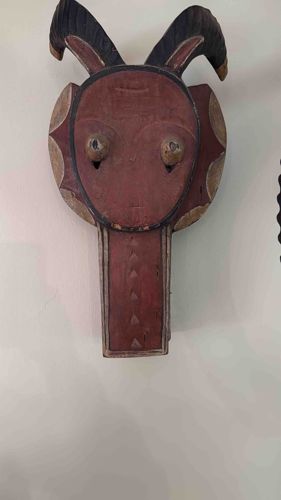
Baule Goli Moon Mask (Kpan Pre)

African Tribal Art & Collectibles

AI Estimated Value

·Not an official valuation·Verify before acting

$350 - $600

As of June 20, 2026

AI Item Analysis

·AI can make mistakes·Verify before acting
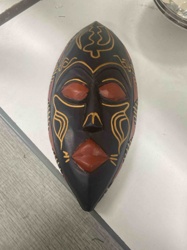
This is a hand-carved polychrome wooden mask, identified as a 'Kpan Pre' or moon mask from the Baule people of Côte d'Ivoire. The piece is characterized by a circular face representing the sun or moon, topped with a pair of curved, dark-stained horns that suggest a goat or antelope. The central face is finished in a weathered reddish-brown earth pigment, framed by a serrated circular border with alternating white and dark triangular sections. Two prominent, protruding cylindrical eyes are situated in the upper half of the face, with small drilled holes for the wearer to see. Below the circular face is a long rectangular beard or bib element, decorated with a vertical row of carved arrow-like geometric incisions. The overall construction appears to be from a single block of medium-density wood. Visible condition includes significant surface patina, pigment loss on the protruding eyes and horns, and several small chips along the edges of the lower rectangular portion. The style suggests it was likely produced in the mid-to-late 20th century, potentially as a decorative object reflecting traditional Goli dance mask iconography. The craftsmanship shows deliberate adze marks on the horns and a rustic, hand-finished quality consistent with West African woodcarving traditions.
AI Appraisal Report

·AI can make mistakes·Verify before acting
I have carefully examined the provided images of this Baule Goli Moon Mask (Kpan Pre). The mask exhibits the classic iconography of the Goli dance, featuring the circular solar/lunar face, projecting cylindrical eyes, and bovine horns. Upon inspection of the surface, the patina appears relatively superficial; the wear on the horns and the pigment loss on the eyes seem consistent with 'distressed' aging rather than the deep, oily patina found on masks with long-term ceremonial use. The carving of the 'beard' and the serrated border shows good hand-tooling, but the execution of the geometric incisions suggests a mid-to-late 20th-century origin, likely produced for the burgeoning West African export market rather than internal ritual utility. Market demand for Baule art remains steady, but the value is highly segmented between 'authentic' pieces with proven field use and 'decorative' pieces. This example falls into the latter category. Comparables for decorative mid-century Kpan Pre masks typically realize between $300 and $700 at regional auctions. The value is bolstered by its aesthetic balance and size, though held back by the lack of documented provenance and the 'dry' nature of the wood. Note: This appraisal is based strictly on visual photographic evidence. A definitive authentication would require a physical inspection to verify the density of the wood, the presence of insect damage, and a microscopic analysis of the pigment layers. Evidence of 'sweat' or wear on the interior reverse side and the attachment holes for the raffia costume would be the primary indicators of authentic dance use. To elevate the valuation, provenance documentation linking the mask to a known collection prior to 1970 would be required.

Get your items appraised

Instant estimates of your treasures with AI-powered appraisals

Browse More Appraisals