These notes were written by the person who submitted this item. Appraiser.AI has not verified them, and the AI's identification and estimate may rely on them.
AI Estimated Value
Not an official valuation
$35-65
AI estimate as of July 6, 2025 · verify with a professional before acting
AI-Generated · Verify before acting
Everything on this page is generated by AI for informational purposes only. AI can make mistakes — the AI may misidentify items or misattribute them (artist, maker, brand, designer, origin, era). This is not an official valuation and should not be used for insurance, sale, tax, estate, legal, or lending purposes — or any decision requiring a certified appraisal. It is not an authoritative claim about any person, brand, or rights holder — do not share or rely on it as a factual statement about a third party. Always consult qualified professionals before making financial decisions.
This analysis also relies on unverified notes provided by the user, which may be incomplete or inaccurate and could affect the result.
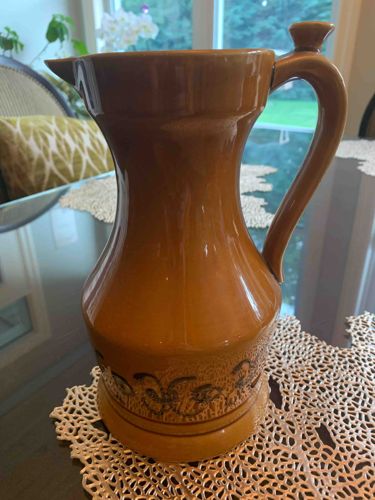
This is a ceramic jug or pitcher, likely used for serving beverages. It features a rich, glossy brown glaze that catches the light, giving it a somewhat rustic yet refined appearance. The form of the pitcher is elegant, with a narrow neck flaring out to a broader base, then narrowing slightly again before flaring out to the foot. The handle is C-shaped, comfortable, and has a small decorative knob at its top attachment point to the rim, which adds a subtle embellishment. The spout is well-defined and V-shaped, designed for pouring. A notable decorative band encircles the lower portion of the body, just above the foot. This band features an impressed or raised pattern that appears to be stylized foliage or an abstract natural motif, rendered in a darker brown or black that provides a subtle contrast against the lighter brown of the body. There are two horizontal incised lines framing the decorative band, one above and one below, adding to the structured design. The craftsmanship seems solid, indicating a functional piece designed with aesthetic appeal. No significant damage like chips or cracks are immediately visible from the provided image, suggesting good overall condition. Patina appears consistent with use.
AI Appraisal Report
Upon visual examination of the provided image, this brown glazed ceramic pitcher appears to be in good overall condition. There are no immediate signs of chips, cracks, or significant damage that would detract from its aesthetic appeal or functionality. The glossy brown glaze shows good reflectivity, and the embossed decorative band with its stylized foliage motif is clearly defined, suggesting solid craftsmanship. The form, with its elegant neck, broad base, and well-designed C-shaped handle and V-shaped spout, indicates a functional piece intended for daily use.
My assessment of authenticity is based solely on visual cues from the image. While the piece presents as an authentic ceramic pitcher of likely 20th-century origin, possibly European or American art pottery, I cannot definitively confirm its age, maker, or specific origin without an in-person examination. For full authentication, I would require a physical inspection to check for maker's marks, pottery shard analysis, or evidence of specific manufacturing techniques. Provenance documentation, such as sales receipts or ownership history, would also be invaluable for establishing a more precise historical context.
Regarding market conditions, ceramic pitchers of this style, while aesthetically pleasing, generally fall into the decorative arts category rather than high-value antiques, unless they are attributed to a renowned pottery or artist. The demand for such utility-ware items is consistent but not exceptionally high. Comparables typically sell in the range of $30-$70 for similar unmarked or lesser-known examples in good condition. Rarity is not a significant factor here; brown-glazed ceramic pitchers were widely produced.
Factors significantly impacting value include condition (which appears good), but more importantly, the lack of definitive maker identification, historical significance, or artistic attribution. Without these, it remains a charming but relatively common decorative item. Should in-person inspection reveal a significant maker's mark or confirm a rare origin, the value could increase considerably.