AI Appraisal Estimate

AI-generated estimates · not official valuations

From the user

What was submitted

Photo and notes provided by the user — not generated by AI

Submitted item photo
Submitted photo · June 12, 2026

User's notes

No additional notes provided.

AI analysis below

AI appraisal

AI analysis & estimate

AI-Generated · Verify before acting

Everything below is generated by AI for informational purposes only. AI can make mistakes — the AI may misidentify items or misattribute them (artist, maker, brand, designer, origin, era). This is not an official valuation and should not be used for insurance, sale, tax, estate, legal, or lending purposes — or any decision requiring a certified appraisal. It is not an authoritative claim about any person, brand, or rights holder — do not share or rely on it as a factual statement about a third party. Always consult qualified professionals before making financial decisions.

Read the full disclaimer

AI Identification

·Not independently authenticated·Verify before acting

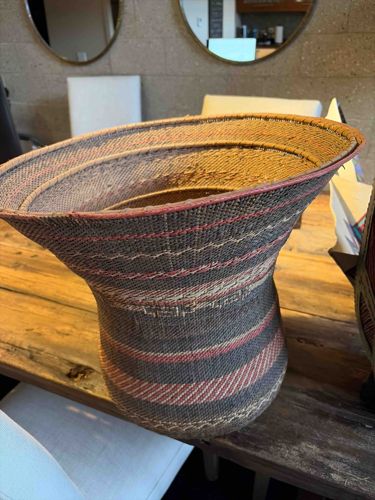
African Coil-Woven Flared Basket

Cultural Art & Textiles / Basketry

AI Estimated Value

·Not an official valuation·Verify before acting

$450 - $650

As of June 12, 2026

AI Item Analysis

·AI can make mistakes·Verify before acting
This is a hand-woven decorative basket featuring a distinct flared silhouette with a wide, out-turned rim and a narrowed neck that tapers into a bulbous base. The item is constructed using a traditional coil-weaving technique utilizing natural plant fibers. The color palette consists of muted earthy tones including charcoal grey, dusty terracotta red, and ivory beige arranged in horizontal banded patterns. Notable decorative elements include zigzag or 'lightning' stitch details along the horizontal bands, which add textural complexity to the piece. The weaving exhibits a high level of craftsmanship with consistent tension and intricate color transitions throughout the vessel. In terms of condition, the basket shows signs of age-related wear; there is a visible indentation or 'slump' on the left side of the upper rim, suggesting either structural softening of the fibers or long-term pressure during storage. There are minor frayed fibers and some light surface dust, but the overall structural integrity remains intact with no significant losses to the weave. The style is characteristic of contemporary African basketry, likely originating from Southern or Eastern African weaving collectives (such as Zulu or Batonga artisans) from the late 20th to early 21st century. The piece stands approximately 10 to 14 inches tall and displays a sophisticated blend of functional tribal form and modern aesthetic appeal.
AI Appraisal Report

·AI can make mistakes·Verify before acting
Based on my visual examination of this coil-woven vessel, I identify it as a contemporary work of Southern African origin, most likely Zulu or Batonga. The piece demonstrates exceptional technical skill, characterized by tight tension and sophisticated horizontal banding with 'lightning' zigzag motifs. The interplay of charcoal, terracotta, and ivory tones indicates the use of high-quality vegetable dyes and seasoned ilala palm or equivalent fibers. The flared silhouette is a more difficult form to execute than standard globes, elevating its aesthetic value. Condition-wise, the basket presents with a notable deflection on the upper rim. While this 'slump' is a common result of humid storage or fiber relaxation in organic materials, it represents a structural deviation that slightly affects the secondary market value. However, the integrity of the weave remains excellent with minimal fraying. Market demand for African utility-as-art remains strong, particularly for pieces that bridge tribal tradition and modern minimalist decor. Comparable contemporary works of this size (10-14 inches) by recognized weaving collectives typically realize $400 to $800 at specialized galleries. The valuation reflects the high labor hours vs. the minor rim deformity. Authenticity Note: As this is a remote visual appraisal, I cannot definitively confirm fiber species or the presence of synthetic vs. natural dyes. A full authentication would require a physical inspection to feel the flexibility of the fibers and a black-light test to check for modern pigment fluorescence. Furthermore, formal provenance—such as lineage to a specific master weaver or acquisition records from a known cooperative—would be required to reach the higher end of the valuation spectrum.

Get your items appraised

Instant estimates of your treasures with AI-powered appraisals

Browse More Appraisals