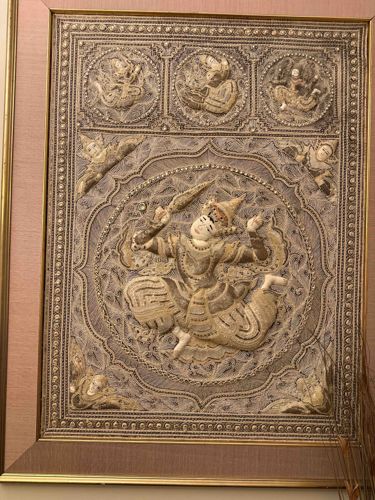
Asian Tapestry with one big picture of a dancer and 4 pictures of some one on corners and 3 minor pictures of dancers, and reflective stones around picture
These notes were written by the person who submitted this item. Appraiser.AI has not verified them, and the AI's identification and estimate may rely on them.
AI Estimated Value
Not an official valuation
$800 - $1,500
AI estimate as of July 19, 2025 · verify with a professional before acting
AI-Generated · Verify before acting
Everything on this page is generated by AI for informational purposes only. AI can make mistakes — the AI may misidentify items or misattribute them (artist, maker, brand, designer, origin, era). This is not an official valuation and should not be used for insurance, sale, tax, estate, legal, or lending purposes — or any decision requiring a certified appraisal. It is not an authoritative claim about any person, brand, or rights holder — do not share or rely on it as a factual statement about a third party. Always consult qualified professionals before making financial decisions.
This analysis also relies on unverified notes provided by the user, which may be incomplete or inaccurate and could affect the result.
This item is a framed Asian tapestry, presenting a three-dimensional, relief-like depiction of figures. The primary material appears to be fabric, potentially silk or a similar fine textile, embellished with intricate metallic threadwork, possibly silver or gold-toned, creating a monochromatic yet highly detailed aesthetic. The overall color palette is muted, featuring shades of beige, cream, and possibly pale grey or silver, with the frame being a complementary dull rose or lavender hue with a golden inner lip. The tapestry showcases a large central figure, likely a dancer or deity, in an active pose, holding a stylized object, possibly a sword or scepter. This central figure is rendered in high relief, with discernible facial features, elaborate headdress, and detailed costume. Surrounding the central motif are intricate patterns and borders, created by dense stitching and outlining. There are four smaller, circular vignettes at the top corners, each containing a figure, and three additional minor figures, possibly dancers or celestial beings, strategically placed around the central image. A notable feature is the integration of small, reflective 'stones' or beads, strategically placed to catch light and add sparkle, particularly around the central figure. The craftsmanship is highly detailed, suggesting meticulous handwork, possibly a form of stumpwork or raised embroidery. No obvious signs of damage such as tears or significant discoloration are apparent from the image, but the age of the piece would suggest some natural patina. The uniformity and intricacy of the threadwork indicate a high level of skill and dedication in its creation. Given the style of costume and figures, it likely originates from Southeast Asian cultures, possibly Burmese or Thai, and could date from the mid-20th century or earlier.
AI Appraisal Report
Based on my detailed visual examination of the provided image of the Framed Asian Embroidered Textile with Dancing Figures, I can offer the following appraisal. The textile appears to be in remarkable condition, showing no overt signs of tears, fraying, or significant discoloration. The metallic threadwork maintains its luster, and the reflective 'stones' are all seemingly intact, indicating careful preservation. The intricacy of the raised embroidery and the density of the stitching suggest genuine handcraftsmanship, aligning with the description of stumpwork or similar raised techniques. The style, particularly the costumes and poses of the figures, strongly aligns with Southeast Asian artistic traditions, likely Burmese or Thai, as suggested.
Regarding authenticity, visually, the piece presents as a genuine artifact of its described type and period (mid-20th century or earlier). However, limitations in remote appraisal are significant. Definitive authentication would require an in-person examination to assess the fiber content, the age of the threads, and the integrity of the 'stones' and their setting. Expert examination could also differentiate between various regional styles more precisely and identify the specific embroidery techniques used. Furthermore, provenance documentation detailing the item's history of ownership would considerably enhance authentication and value.
In terms of market conditions, intricately detailed textile art from Southeast Asia holds a niche but consistent demand among collectors of Asian arts and textiles. Comparables from reputable auction houses and galleries suggest that pieces of this craftsmanship and apparent age, especially those exhibiting three-dimensional relief features, command reasonable prices. The visual appeal, the detailed workmanship, and the apparent good condition contribute positively to its marketability. While not exceedingly rare, high-quality, well-preserved examples are less common.
Factors impacting value positively include the apparent excellent condition, the superior craftsmanship evidenced by the detailed raised embroidery and metallic threads, and the captivating subject matter. The aesthetic appeal and decorative quality are high, making it desirable for art collectors and interior decorators alike. Conversely, the lack of definitive origin attribution (specific country or region within Southeast Asia) and precise age (mid-20th century or earlier is broad) without further examination slightly limits its top-tier investment potential. Without provenance, its history and authenticity cannot be fully verified, which is the primary factor limiting a higher valuation. Scientific testing, such as carbon dating for fabrics or metallurgical analysis of threads, when feasible and appropriate, would provide crucial data for full authentication.