AI estimate as of July 6, 2025 · verify with a professional before acting
AI-Generated · Verify before acting
Everything on this page is generated by AI for informational purposes only. AI can make mistakes — the AI may misidentify items or misattribute them (artist, maker, brand, designer, origin, era). This is not an official valuation and should not be used for insurance, sale, tax, estate, legal, or lending purposes — or any decision requiring a certified appraisal. It is not an authoritative claim about any person, brand, or rights holder — do not share or rely on it as a factual statement about a third party. Always consult qualified professionals before making financial decisions.
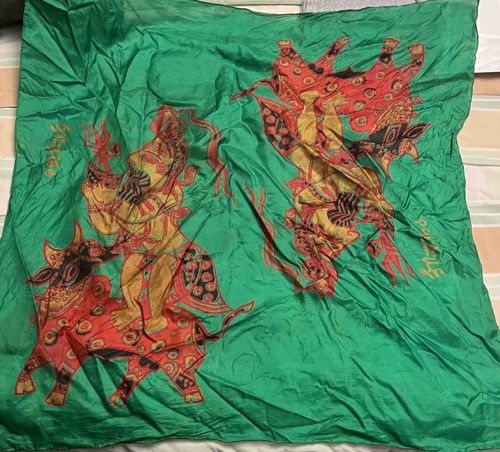
This item is a green textile, likely silk or a silk blend, featuring two vibrantly colored depictions of figures and animals, possibly mythological or religious in nature, executed in a style reminiscent of traditional Southeast Asian or South Asian artistry. The primary color of the textile is a rich, somewhat muted emerald green, which serves as a striking background for the intricate designs. The fabric exhibits a slight sheen, suggesting a smooth, fine weave, though it is currently wrinkled, indicating its pliable nature. Each figural scene is dominated by shades of red, gold, black, and hints of orange. One prominent motif shows a human-like figure, possibly a deity, riding a stylized bull or bovine creature. This figure is adorned with elaborate headwear, what appears to be a trident-like object, and decorative patterns on their clothing and body. The bull is rendered in red with black and gold circular or oval embellishments. Adjacent to this, another similar figure, either a different entity or another portrayal of the same, is depicted in a dynamic pose, also with intricate patterns and vibrant colors. The design work suggests a hand-painted or batik technique due to the organic lines and slight imperfections in the color application, lending an artisanal quality. There are no readily visible maker's marks or signatures, though one area seems to have faint, illegible script or symbols. The edges appear hemmed, but the overall shape is somewhat irregular, possibly due to a lack of tension or framing. The textile shows signs of age and use, including creasing and general wear, but no obvious tears or holes. The colors remain largely vivid, indicating good dye fastness. Its size appears to be that of a medium to large scarf or a decorative wall hanging, approximately square in shape. The craftsmanship is indicative of a decorative piece, likely from the mid to late 20th century, given the artistic style and perceived material quality.
AI Appraisal Report
Upon visual examination of this green textile with mythological motifs, I assess its condition as good, considering its apparent age. While creasing and general wear are evident, there are no visible tears or holes, and the colors largely retain their vibrancy, indicating good dye fastness. The execution style, reminiscent of traditional Southeast or South Asian artistry with its organic lines and slight imperfections, suggests either hand-painting or a batik technique, lending an artisanal quality. The lack of distinct maker's marks or signatures, combined with the perceived artistic style and material quality, points towards a decorative piece likely from the mid to late 20th century.
From a market perspective, comparable items, often referred to as 'ethnic textiles' or 'folk art tapestries,' vary widely in value based on verifiable age, origin, and condition. Pieces with documented provenance, known artists, or exceptional age command significantly higher prices. Currently, there is a steady but not exceptionally high demand for such decorative textiles, with rarity being a key value driver. This piece, while visually appealing, does not immediately present characteristics of extreme rarity without further information.
Factors significantly impacting its value include the absence of verifiable origin, which is crucial for authenticating its cultural significance and age. The faint, illegible script is intriguing but cannot be deciphered from the image, limiting authentication. Without clear provenance or an identifiable artist, the primary value rests on its decorative appeal and condition.
It is important to note the limitations of my authenticity verification based solely on images. To fully authenticate and accurately appraise this textile, an in-person examination is crucial. This would allow for a tactile assessment of the fabric type, a detailed inspection of the weave and dye application, and a clearer examination of any latent symbols or script. Microscopic analysis of fibers and dyes could help determine age and origin. Provenance documentation, such as receipts or family history, would also be invaluable in establishing its historical context and authenticity.