These notes were written by the person who submitted this item. Appraiser.AI has not verified them, and the AI's identification and estimate may rely on them.
AI Estimated Value
Not an official valuation
$800-1,500
AI estimate as of July 23, 2025 · verify with a professional before acting
AI-Generated · Verify before acting
Everything on this page is generated by AI for informational purposes only. AI can make mistakes — the AI may misidentify items or misattribute them (artist, maker, brand, designer, origin, era). This is not an official valuation and should not be used for insurance, sale, tax, estate, legal, or lending purposes — or any decision requiring a certified appraisal. It is not an authoritative claim about any person, brand, or rights holder — do not share or rely on it as a factual statement about a third party. Always consult qualified professionals before making financial decisions.
This analysis also relies on unverified notes provided by the user, which may be incomplete or inaccurate and could affect the result.
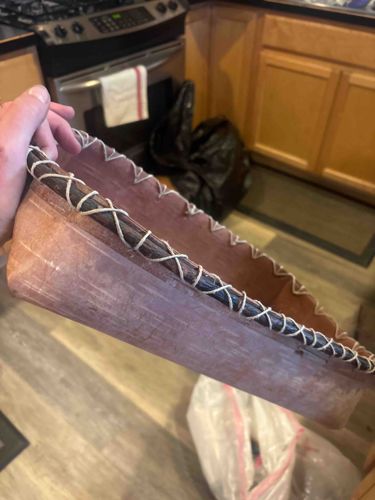
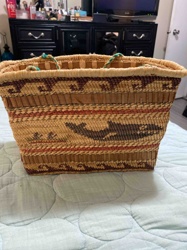
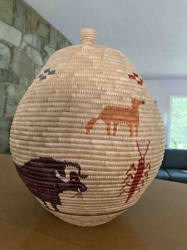
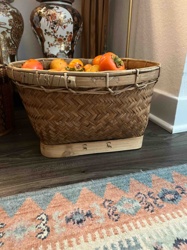
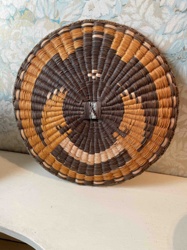
This item appears to be a traditional Native Alaskan bentwood box, often associated with cultures indigenous to the Northwest Coast and Alaska. It is characterized by its elongated, rectangular or boat-like form, constructed from a single plank of wood that is kerfed (grooved) and steamed to allow for bending at the corners, creating seamless sides. The natural reddish-brown hue of the wood, possibly cedar or spruce, is visible, showing a slightly weathered or aged patina with subtle variations in color and grain. The top rim of the box is reinforced by what appears to be a dark-colored wooden or possibly whalebone rod, which is securely lashed to the box rim with coarse, natural-colored (likely sinew or sturdy plant fiber) lacing. This lacing follows a distinctive criss-cross or X-pattern, creating a decorative yet functional edge. The lashing appears robust and tightly executed, indicating good craftsmanship. The interior of the box shows the natural, unfinished surface of the wood, with a roughly cut or perhaps chewed edge detail that creates a decorative, 'scalloped' or 'zig-zag' pattern along the entire top interior rim just below the lashing. This specific decorative cut suggests a traditional hand-shaping method. There are no obvious visible signs of cracking or major damage, though the surface exhibits some typical wear congruent with a handcrafted item of its type and age, possibly including minor abrasions or discoloration. The overall construction points to an authentic, handcrafted piece, likely from the late 19th to mid-20th century, reflecting the material culture and artistic traditions of Alaskan indigenous communities. The quality of the joining and lashing suggests a skilled artisan.
AI Appraisal Report
Based on my remote visual examination of the provided images and the owner's description, this Alaskan Native Bentwood Box appears to be an authentic, handcrafted piece consistent with the material culture of indigenous communities from the Northwest Coast and Alaska. The construction, utilizing a single kerfed and steamed plank, reinforced rim with lashing, and the distinctive interior scalloped edge, aligns perfectly with traditional methods. The 'natural reddish-brown hue' and 'slightly weathered or aged patina' suggest appropriate age and natural wear. The 'tightly executed' lashing and 'robust' construction indicate a skilled artisan.
I assess the condition as good, commensurate with age and use, with no visible major cracks or damage. Minor abrasions and discoloration are expected for an item of this type and proposed age.
Market conditions for authentic Alaskan Native cultural art, particularly well-preserved bentwood boxes, are stable with consistent demand among private collectors and institutions. Comparables for similar undocumented pieces from the late 19th to mid-20th century typically range significantly based on provenance and artistic quality.
Factors impacting value include its presumed authenticity, good condition, and traditional craftsmanship. The 'scalloped' interior edge is a desirable traditional detail.
However, it is crucial to note the limitations of remote appraisal. While the visual evidence strongly suggests authenticity, definitive verification requires in-person examination to assess wood species, joinery, and patination tactilely. Provenance documentation (e.g., date of acquisition, family history, tribal association) would significantly enhance value and authenticity. Scientific testing, such as dendrochronology or material analysis, could provide a more precise age and material identification, solidifying its provenance. Without such physical examination or documentation, the authenticity assessment remains presumptive, albeit strongly supported by visual cues.