AI estimate as of September 10, 2025 · verify with a professional before acting
AI-Generated · Verify before acting
Everything on this page is generated by AI for informational purposes only. AI can make mistakes — the AI may misidentify items or misattribute them (artist, maker, brand, designer, origin, era). This is not an official valuation and should not be used for insurance, sale, tax, estate, legal, or lending purposes — or any decision requiring a certified appraisal. It is not an authoritative claim about any person, brand, or rights holder — do not share or rely on it as a factual statement about a third party. Always consult qualified professionals before making financial decisions.
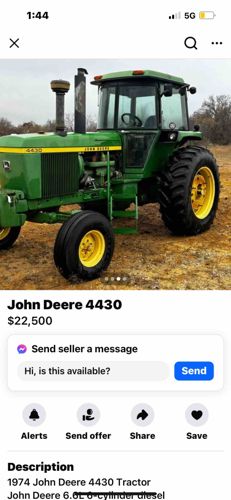
This is a 1974 John Deere 4430 Tractor, characterized by its iconic John Deere green body with yellow accents on the wheels and side stripe. The tractor features a substantial, robust construction, typical of agricultural machinery from its era. It is equipped with a fully enclosed operator's cab, indicating a design focused on operator comfort and protection, which became more common in the 1970s. The cab appears to have glass windows on all visible sides and a sun visor above the windshield. A prominent, tall exhaust stack is visible on the left side of the engine compartment, suggesting a powerful diesel engine, specifically identified as a John Deere 6.6L 6-cylinder diesel according to the provided information. The tractor sits on large, deep-tread rear tires, essential for traction in various terrains, and smaller, dual front tires, also with a ribbed tread pattern. While the overall condition appears to be good for its age, a detailed inspection would be needed to identify specific wear or damage. Minor scratches, faded paint, or some surface rust could be expected on a machine of this age, though these are not clearly discernible from the image. The general craftsmanship appears to be industrial-grade, built for durability and heavy-duty farm work. No specific maker's marks or signatures are clearly visible beyond the 'John Deere' branding and '4430' model number on the side of the engine hood.
AI Appraisal Report
Based on my visual examination of the 1974 John Deere 4430 Tractor, I assess its condition as good for its age. The iconic John Deere green with yellow accents and the prominent '4430' model number confirm its authenticity as a John Deere product. The presence of the enclosed operator's cab and the tall exhaust stack consistent with the specified John Deere 6.6L 6-cylinder diesel engine further support its authenticity relative to this model. While the overall appearance is robust and indicative of its original industrial-grade construction for heavy-duty farm work, without a physical inspection, I cannot confirm the functionality of all mechanical components, the true extent of any paint fading, minor scratches, or surface rust, nor the integrity of the hydraulic lines, electrical system, or internal engine components.
Market conditions for vintage John Deere tractors, particularly well-regarded models like the 4430, remain strong. These machines are sought after for both their utility on smaller farms and for collectible purposes. Comparables in similar apparent condition often range significantly depending on hours of use, maintenance history, and specific features. The demand for these workhorse tractors is relatively stable, driven by their reputation for reliability and parts availability. While not exceedingly rare, a well-preserved 4430 from 1974 is becoming less common. Significant factors impacting value include engine hours (not visible), transmission type, PTO functionality, and the overall mechanical state.
Limitations in authenticity verification from images alone are significant. For full authentication and a precise valuation, an in-person examination is crucial. This would involve inspecting the engine for leaks, checking the hydraulics, testing the transmission, assessing tire condition and wear patterns, and verifying all gauges and lights. Provenance documentation, such as service records and previous ownership history, would be invaluable. While scientific testing is not typically required for tractors of this age, a comprehensive mechanical inspection by a qualified technician would provide the most accurate assessment of its operational integrity and true value.