AI Appraisal Estimate

AI-generated estimates · not official valuations

From the user

What was submitted

Photo and notes provided by the user — not generated by AI

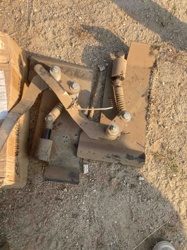
Submitted item photo
Submitted photo · May 25, 2026

User's notes

No additional notes provided.

AI analysis below

AI appraisal

AI analysis & estimate

AI-Generated · Verify before acting

Everything below is generated by AI for informational purposes only. AI can make mistakes — the AI may misidentify items or misattribute them (artist, maker, brand, designer, origin, era). This is not an official valuation and should not be used for insurance, sale, tax, estate, legal, or lending purposes — or any decision requiring a certified appraisal. It is not an authoritative claim about any person, brand, or rights holder — do not share or rely on it as a factual statement about a third party. Always consult qualified professionals before making financial decisions.

Read the full disclaimer

AI Identification

·Not independently authenticated·Verify before acting

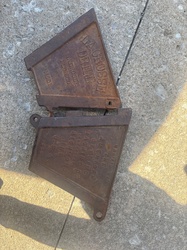
Vintage Cast Iron Tractor Suitcase Weight

Agricultural Machinery Parts / Industrial Equipment

AI Estimated Value

·Not an official valuation·Verify before acting

$45.00 - $75.00

As of May 25, 2026

AI Item Analysis

·AI can make mistakes·Verify before acting
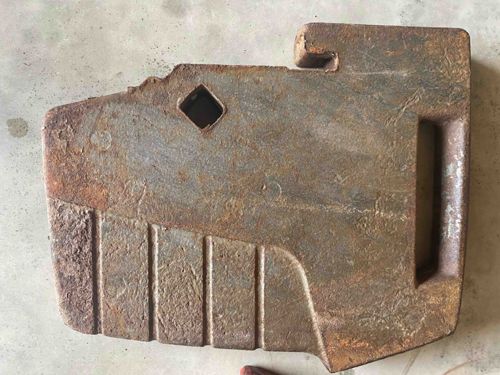
This is a heavy-duty industrial or agricultural component, specifically a cast iron 'suitcase' style counterweight used for stabilizing farm tractors or heavy machinery. The item is monolithic, cast in a single piece of iron with a thick block-like profile. It features several functional design elements: a built-in handle slot on the right side for manual lifting, a top notch for securing it to a bracket, and a square central cutout likely for a mounting bolt or hitch pin. The bottom-left section displays five vertical grooved ridges, which serve both as structural reinforcement and to aid in stacking multiple weights side-by-side without shifting. Physically, the item shows significant evidence of use and exposure to the elements. It is covered in a dense, uniform layer of surface oxidation (rust), resulting in a gritty, matte brown-orange patina. The casting appears coarse, with 'orange peel' textures and minor pitting typical of industrial sand-casting methods. There are visible chips and impact marks along the top edge, suggesting repeated mechanical stress. While no specific manufacturer logo is immediately visible due to the rust, the distinct geometric shape and ridge pattern are characteristic of agricultural equipment from the mid-to-late 20th century. The sheer density and lack of hollow sections indicate high-quality, high-mass construction designed for utility over aesthetics.
AI Appraisal Report

·AI can make mistakes·Verify before acting
I have examined the provided images of this cast iron suitcase weight, a quintessential piece of 20th-century agricultural utility gear. The item displays a uniform, heavy oxidation patina and surface pitting consistent with prolonged outdoor exposure and industrial use. The casting reveals characteristic 'orange peel' textures and minor impact chipping on the edges, confirming its functional life as a counterbalance. While the specific manufacturer—such as John Deere, Case, or International Harvester—is obscured by the rust layer, the five-ridge interlocking design is a standard feature for mid-to-late century tractor weights. The current market for vintage suitcase weights is driven primarily by modern-day utility rather than high-end collectibility. Comparable sales for weights in this 40–100lb range typically hover around $1.00 per pound, though branded 'stacker' weights from specific legacy lines can fetch a premium. The heavy rust present here, while aesthetically 'vintage,' may detract from the value for active agricultural users unless restored, whereas it may appeal to the 'industrial decor' market. Critically, a definitive valuation is limited by the inability to physically weigh the item or inspect for structural cracks hidden beneath the oxidation. To fully authenticate the manufacturer and confirm its market ceiling, an in-person examination is required to identify embossed part numbers often found on the mating surface. Scientific testing is generally not warranted for such common industrial items; however, provenance regarding the specific model of tractor it was paired with could marginally increase its appeal to restorers.

Get your items appraised

Instant estimates of your treasures with AI-powered appraisals

Browse More Appraisals