AI Appraisal Estimate

AI-generated estimates · not official valuations

From the user

What was submitted

Photo and notes provided by the user — not generated by AI

Submitted item photo
Submitted photo · June 22, 2026

User's notes

No additional notes provided.

AI analysis below

AI appraisal

AI analysis & estimate

AI-Generated · Verify before acting

Everything below is generated by AI for informational purposes only. AI can make mistakes — the AI may misidentify items or misattribute them (artist, maker, brand, designer, origin, era). This is not an official valuation and should not be used for insurance, sale, tax, estate, legal, or lending purposes — or any decision requiring a certified appraisal. It is not an authoritative claim about any person, brand, or rights holder — do not share or rely on it as a factual statement about a third party. Always consult qualified professionals before making financial decisions.

Read the full disclaimer

AI Identification

·Not independently authenticated·Verify before acting

Art Deco Uranium Glass Figural Decanter

Antique Glassware / Collectibles

AI Estimated Value

·Not an official valuation·Verify before acting

$450.00 - $650.00

As of June 22, 2026

AI Item Analysis

·AI can make mistakes·Verify before acting
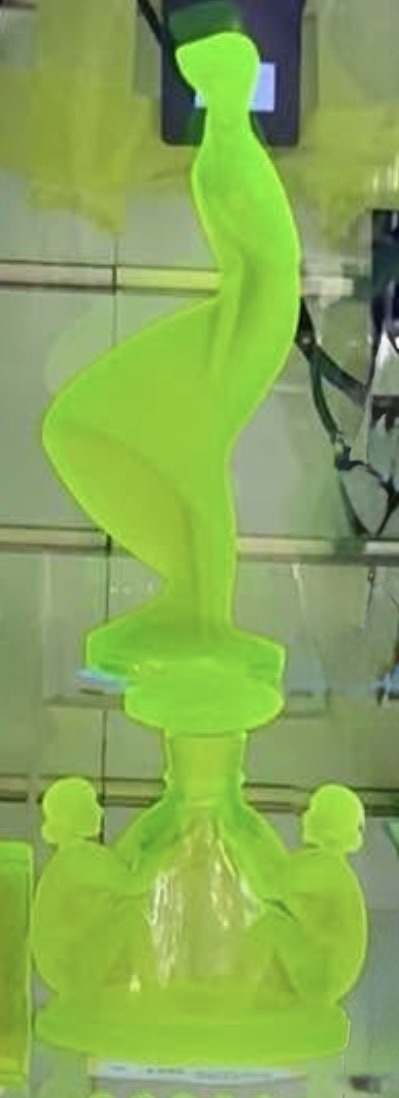
This is a striking example of Art Deco era glasswork, specifically a figural decanter made of uranium glass, also known as Vaseline glass. The piece glows with an intensely bright neon green hue when exposed to ultraviolet light, a characteristic resulting from the addition of uranium oxide to the glass melt. The design features a stylized female figure silhouette, characterized by the streamlined, curvaceous forms and geometric elegance typical of the 1920s to 1930s Art Deco movement. The decanter consists of two primary components: a bulbous glass base with integrated figural handles depicting female busts in profile, and a large, tall stopper that mirrors the elongated form of a woman in a dramatic, sweeping pose. The glass displays a uniform color throughout with a frosted or satin finish, which softens the light and emphasizes the sculptural contours. Based on its style and material, the item likely dates between 1925 and 1940. The craftsmanship is high, showing consistent wall thickness and seamless integration of the figural elements. No visible cracks or major chips are apparent in the image, though typical light shelf wear on the bottom base is expected for its age. This piece represents a marriage of functional barware and decorative sculpture, highly sought after by collectors of fluorescence-reactive glassware and Art Deco design.
AI Appraisal Report

·AI can make mistakes·Verify before acting
Based on my visual examination of the Art Deco uranium glass figural decanter, I find it to be a high-quality piece likely of European origin, possibly Tiffin or a specialized Bohemian manufacturer like Hoffman or Curt Schlevogt, dating to the late 1920s or 1930s. The satin finish is consistent with the era’s 'Malachite' or 'Lapis' style glass experiments, though rendered here in a vibrant uranium-oxide formulation. The figural stopper and integrated handles show excellent Mold work with sharp definitions, suggesting it was produced using a high-quality master mold. Market demand for fluorescent glassware remains robust, particularly for figural 'Nymph' or 'Goddess' motifs which command a premium over standard geometric patterns. Comparables for complete sets with original stoppers in good condition typically hammer between $400 and $700 at specialized auction houses. The primary value drivers here are the presence of the original stopper and the intensity of the UV reaction. However, as this appraisal is based on digital images, I must note significant limitations. Visual inspection cannot identify internal stress fractures, microscopic 'flea bites' at the stopper neck, or the exact weight/lead content of the glass. Full authentication would require an in-person examination to verify the 'ring' of the glass, a search for acid-etched signatures, and ideally, documentation tracing the piece to a specific glasshouse catalog. Without physical handling, the risk of modern reproductions—many of which are currently coming out of Eastern Europe—cannot be entirely eliminated, though the patina and wear shown here appear consistent with an authentic 20th-century antique.

Get your items appraised

Instant estimates of your treasures with AI-powered appraisals

Browse More Appraisals