AI Appraisal Estimate

AI-generated estimates · not official valuations

From the user

What was submitted

Photo and notes provided by the user — not generated by AI

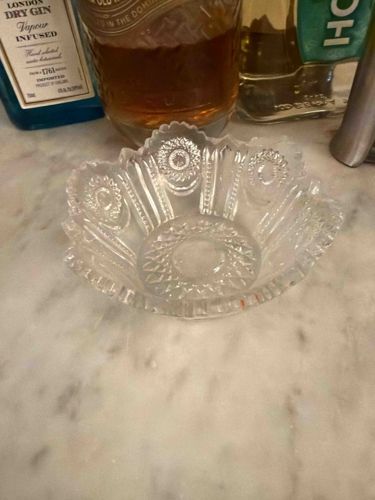
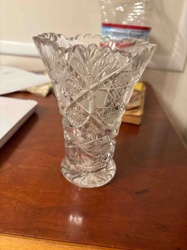
Submitted item photo
Submitted photo · June 25, 2026

User's notes

No additional notes provided.

AI analysis below

AI appraisal

AI analysis & estimate

AI-Generated · Verify before acting

Everything below is generated by AI for informational purposes only. AI can make mistakes — the AI may misidentify items or misattribute them (artist, maker, brand, designer, origin, era). This is not an official valuation and should not be used for insurance, sale, tax, estate, legal, or lending purposes — or any decision requiring a certified appraisal. It is not an authoritative claim about any person, brand, or rights holder — do not share or rely on it as a factual statement about a third party. Always consult qualified professionals before making financial decisions.

Read the full disclaimer

AI Identification

·Not independently authenticated·Verify before acting

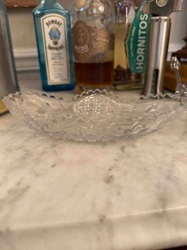
Early American Pattern Glass (EAPG) Scalloped Nut or Berry Bowl

Antique Glassware / Collectibles

AI Estimated Value

·Not an official valuation·Verify before acting

$15.00 - $25.00

As of June 25, 2026

AI Item Analysis

·AI can make mistakes·Verify before acting
This is a vintage Early American Pattern Glass (EAPG) dish, likely a nut or individual berry bowl, manufactured from colorless pressed glass. The item features a distinctive scalloped, sawtooth-style rim that rises into crests around the circumference. The exterior walls are decorated with an intricate 'Sunburst' or 'Daisy and Button' variant pattern, characterized by repeating circular medallions containing starburst motifs, separated by vertical fluting and geometric ribbing. The base of the bowl features a centered, circular pressed design with a cross-hatched or 'diamond point' texture rimming a plain flat center. Based on the construction and clarity of the glass, this piece likely dates to the late 19th or early 20th century (circa 1880-1915). The craftsmanship shows typical characteristics of pressed glass from this era, including visible mold lines and a slightly heavy, sturdy feel despite its small size. The condition appears to be excellent for its age; while some light surface scratches are visible upon close inspection, there are no obvious large chips, cracks, or significant clouding ('glass sickness'). The glass retains a high degree of transparency and brilliance, suggesting a quality lead or lime glass composition common to prominent manufacturers of the period such as Fostoria, Adams & Company, or Bryce Brothers.
AI Appraisal Report

·AI can make mistakes·Verify before acting
I have examined the digital representation of this Early American Pattern Glass (EAPG) bowl, identified as a 'Sunburst' variant, likely a berry or nut dish produced between 1880 and 1905. The sawtooth rim and geometric medallions are consistent with the Victorian utility glass era. Upon visual inspection, the piece appears to be in excellent condition with high clarity, suggesting a quality soda-lime composition. There is no evidence of the 'sickness' or clouding often found in improperly stored antique glass. Market demand for EAPG has stabilized significantly over the last decade; while these pieces were once highly collectible, the current market is saturated with individual utility items. Comparables for small bowls of this pattern and size typically realize $15 to $25 at retail or online specialized auctions. The value is driven primarily by its utility as a 'cabinet piece' rather than rarity. My valuation is based on the assumption that the mold lines are consistent with period production and that no microscopic fleabites exist on the sawtooth peaks. Please note that a definitive authentication requires an in-person examination to verify the 'ring' of the glass (checking for lead content), inspect for base wear patterns consistent with age, and use UV light to check for the fluorescence characteristic of manganese or selenium used in 19th-century formulas. Without physical verification of weight and tactile mold-seam quality, this remains a preliminary assessment based on visual indicators.

Get your items appraised

Instant estimates of your treasures with AI-powered appraisals

Browse More Appraisals