These notes were written by the person who submitted this item. Appraiser.AI has not verified them, and the AI's identification and estimate may rely on them.
AI Estimated Value
Not an official valuation
$75-125
AI estimate as of November 2, 2025 · verify with a professional before acting
AI-Generated · Verify before acting
Everything on this page is generated by AI for informational purposes only. AI can make mistakes — the AI may misidentify items or misattribute them (artist, maker, brand, designer, origin, era). This is not an official valuation and should not be used for insurance, sale, tax, estate, legal, or lending purposes — or any decision requiring a certified appraisal. It is not an authoritative claim about any person, brand, or rights holder — do not share or rely on it as a factual statement about a third party. Always consult qualified professionals before making financial decisions.
This analysis also relies on unverified notes provided by the user, which may be incomplete or inaccurate and could affect the result.
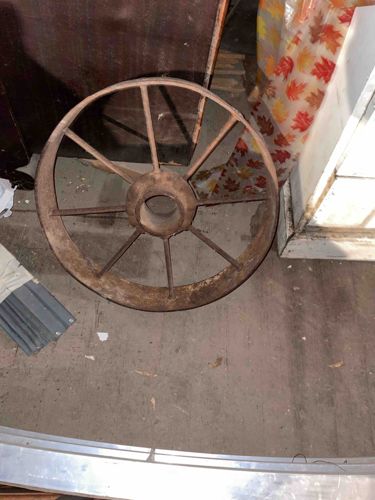
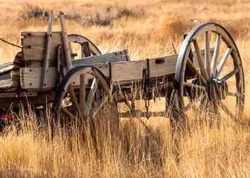
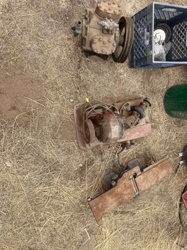
This is an antique cast iron wagon wheel, likely dating from the late 19th to early 20th century, consistent with the design prevalent for agricultural equipment or carts from that period. The wheel appears to be constructed entirely from cast iron, evident from its robust, heavy appearance and the visible texture, suggesting a sand-cast production process. It features a central hub with a circular opening, designed to accommodate an axle, surrounded by a series of eight evenly spaced, solid spokes that radiate outwards to integrate with the wheel's rim. The rim itself is substantial, indicating it was designed for durability and load-bearing capacity. The overall color is a deep, reddish-brown, indicative of significant surface rust and patina that has developed over many years of exposure and use. There are no immediate signs of repairs or significant structural damage like cracks or breaks, though the extensive rust suggests it has been stored in conditions that promoted oxidation. The edges of the spokes and rim appear to be worn smooth in places, consistent with prolonged contact with dirt and uneven surfaces. No discernible maker's marks, signatures, or stamps are visible in the provided images. The craftsmanship, while utilitarian, reflects the sturdy and functional requirements of the era for such an item. Its historical context likely places it as a component of a horse-drawn wagon, cart, or perhaps early industrial equipment. The absence of a rubber tire further supports its age prior to the widespread adoption of such innovations.
AI Appraisal Report
Upon my virtual examination of the provided image and the owner's description of this antique cast iron wagon wheel, I assess its a likely authentic late 19th to early 20th-century agricultural or industrial component. The robust construction, eight-spoke design, and visible sand-cast texture are consistent with manufacturing practices of that period. Its reddish-brown coloration indicates extensive surface rust and a thick patina, which, while aesthetically pleasing to some, also suggests considerable exposure to elements. Crucially, I see no immediate signs of structural damage like cracks or breaks, which preserves its integrity for decorative or repurposing uses. The wear on the spokes and rim further supports its utilitarian past. There are no maker's marks visible, which is common for such functional items.
Market conditions for single antique cast iron wagon wheels are generally stable but not particularly high. Comparables typically sell in the range of $50 to $150, depending on size, condition, and artistic appeal (e.g., more decorative spokes). Demand is driven primarily by decorators, landscapers, and DIY enthusiasts seeking rustic accents for gardens or furniture. Rarity is not a significant factor here; while old, these wheels were mass-produced. The primary value drivers are its intact condition, aesthetic appeal of the patina, and size. Absence of cracks significantly impacts the upper end of the value.
Limitations in authenticity verification from images alone include the inability to physically assess weight, exact dimensions, and the depth of the rust pitting. An in-person examination would allow me to tap the wheel for sound (indicating cracks not visible), feel the texture, and better gauge the overall structural integrity. Provenance documentation, while unlikely for such a utilitarian item, would confirm its history. Scientific testing, such as material analysis, would definitively confirm its age and composition, though this is typically not practical or necessary for items in this value range. Based on my current assessment, I place the appraisal value between $75 and $125.