AI estimate as of September 11, 2025 · verify with a professional before acting
AI-Generated · Verify before acting
Everything on this page is generated by AI for informational purposes only. AI can make mistakes — the AI may misidentify items or misattribute them (artist, maker, brand, designer, origin, era). This is not an official valuation and should not be used for insurance, sale, tax, estate, legal, or lending purposes — or any decision requiring a certified appraisal. It is not an authoritative claim about any person, brand, or rights holder — do not share or rely on it as a factual statement about a third party. Always consult qualified professionals before making financial decisions.
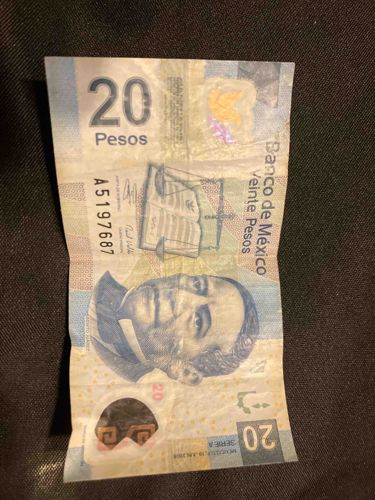
This item is a 20 Pesos banknote from Mexico, commonly referred to as a 'veinte pesos' bill. The banknote is primarily light blue and off-white in color, with various shades of blue, red, yellow, and purplish-pink visible in the design and security features. It appears to be made of a polymer material, which is typical for modern Mexican banknotes, indicated by its slightly glossy appearance and the presence of a translucent window. The note features a prominent portrait of a historical figure, likely Benito Juárez, on the obverse. Above the portrait, the denomination "20 Pesos" is clearly printed, along with the serial number 'A 5197687' oriented vertically. To the right of the portrait, the text "Banco de México" and "Veinte Pesos" are written vertically. A distinctive security feature is visible near the bottom left: a clear, semicircular window incorporating what appears to be a metallic or holographic element, possibly depicting a symbol or the numeral '20'. Another number '20' is visible in the bottom right corner, oriented horizontally. The banknote exhibits signs of use, including several vertical and horizontal creases and folds, indicating that it has been circulated. There are some minor smudges or discolorations visible, particularly around the edges and within the lighter areas. The overall condition suggests Good to Very Good circulated state, with no apparent tears or major damage, though the folds are quite pronounced. The design incorporates intricate patterns and fine line work, characteristic of secure currency printing, with a visible watermark or security thread embedded in the material. The style is distinctly modern banknote design from the 21st century, with the 'SERIE A 2008' text visible, suggesting it belongs to a series issued around or after 2008.
AI Appraisal Report
Based on my visual examination of the Mexico 20 Pesos banknote, it appears to be an authentic circulating polymer note from the 'Serie A 2008' issue. The features described, such as the portrait of Benito Juárez, the translucent window with a potential holographic element, and the polymer material, align with known characteristics of these banknotes. The serial number 'A 5197687' and the '20 Pesos' denomination are clearly visible. Its condition, as evidenced by the numerous vertical and horizontal creases and folds, as well as minor smudges, suggests a circulated state, likely Good to Very Good. While there are no apparent tears or major damage, the pronounced folds reduce its collectible value significantly.
From a market perspective, these 20 Pesos banknotes are very common in Mexico and are readily available. Current market conditions for circulated Mexican polymer banknotes typically see them trading very close to their face value, especially for common series like this one. There is no significant rarity associated with this particular serial number or series in a circulated condition. Demand for circulated common currency is low among collectors, as they generally seek uncirculated or near-perfect examples. The primary factor impacting its value is its circulated condition, which places it firmly in the realm of face value or slightly above for a collector who might want a representative example.
It is crucial to note that this authenticity verification is based solely on visual examination of the provided image. For full authentication, an in-person physical examination would be necessary to inspect security features like the metallic element's luminescence, the tactile feel of the polymer, and to check for hidden security threads or microprinting. Provenance documentation is not typically relevant for common circulating banknotes. Scientific testing (e.g., UV light examination) would also be needed to confirm all security features and rule out counterfeiting definitively. However, based on the image, it presents as a genuine, heavily circulated banknote.