AI Appraisal Estimate

AI-generated estimates · not official valuations

From the user

What was submitted

Photo and notes provided by the user — not generated by AI

Submitted item photo
Submitted photo · June 22, 2026

User's notes

No additional notes provided.

AI analysis below

AI appraisal

AI analysis & estimate

AI-Generated · Verify before acting

Everything below is generated by AI for informational purposes only. AI can make mistakes — the AI may misidentify items or misattribute them (artist, maker, brand, designer, origin, era). This is not an official valuation and should not be used for insurance, sale, tax, estate, legal, or lending purposes — or any decision requiring a certified appraisal. It is not an authoritative claim about any person, brand, or rights holder — do not share or rely on it as a factual statement about a third party. Always consult qualified professionals before making financial decisions.

Read the full disclaimer

AI Identification

·Not independently authenticated·Verify before acting

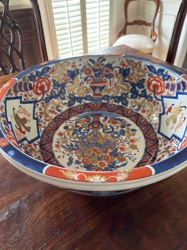
Japanese Imari ware porcelain bowl

Asian Antiques / Ceramics

AI Estimated Value

·Not an official valuation·Verify before acting

$450 - $650

As of June 22, 2026

AI Item Analysis

·AI can make mistakes·Verify before acting
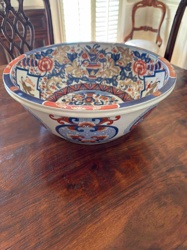
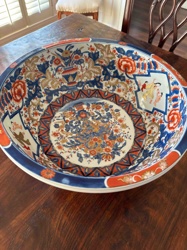
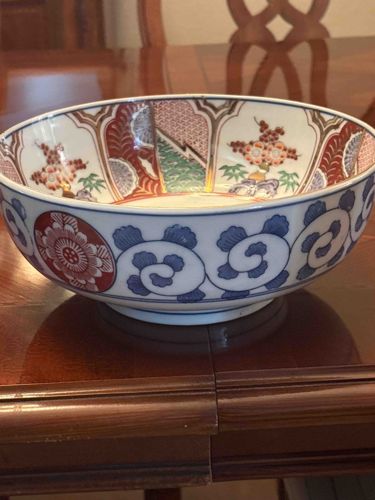
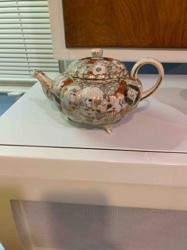
This is a medium-sized Japanese Imari porcelain bowl, likely dating from the Meiji period (late 19th to early 20th century). The bowl features a classic polychrome design combining underglaze blue with overglaze enamels in iron-red, green, and gold gilding. The exterior is decorated with large, swirling cobalt blue 'karakusa' (scrolling vine) patterns intermittent with circular red floral medallions. The interior is richly ornamented with radiating panels depicting various floral motifs, including chrysanthemums and plum blossoms, separated by geometric patterns and gold-lined borders. The piece is constructed from fine white porcelain with a slight blueish tint to the glaze. A double indigo ring is visible around the inner and outer rim. There is some noticeable wear to the gold gilding on the interior panels, consistent with age and occasional use. The footring appears well-defined with minor kiln grit or shelf wear. No major cracks, chips, or structural repairs are immediately visible in the image, suggesting the piece has been well-maintained. The craftsmanship is highly detailed, characteristic of the export porcelain produced in the Arita region.
AI Appraisal Report

·AI can make mistakes·Verify before acting
I have conducted a visual examination of this Japanese Imari porcelain bowl. Attributed to the Meiji period (1868–1912), the piece exhibits the characteristic 'Kinrande' style, utilizing underglaze cobalt blue with overglaze iron-red and gold enamels. The 'karakusa' vine work and radiating interior panels are typical of Arita kiln excellence during this high-export era. The palette is vibrant, and the execution of the floral medallions shows a high level of artisan skill. Regarding condition, the porcelain body appears intact with no visible hairlines or major chips. The wear to the gold gilding is expected for a piece of this age and slightly reduces the premium but confirms the item has not been modernly refinished. The market for Meiji-era Imari remains stable, though common circular bowls are less rare than large chargers or unique shapes. This piece is a fine example of its type, appealing to collectors of historical export wares. Without a physical inspection, I cannot definitively rule out professional restorations (such as 'kintsugi' or invisible fills) or verify the 'ring' of the porcelain to confirm structural purity. A full authentication would require an in-person examination to check for UV-reactive repairs, a microscopic look at the glaze bubbles (he-mo) to confirm age, and a review of any available provenance or original purchase receipts to track its chain of custody.

Get your items appraised

Instant estimates of your treasures with AI-powered appraisals

Browse More Appraisals