Chinese Famille Verte Dragon Cizhou-style Vase
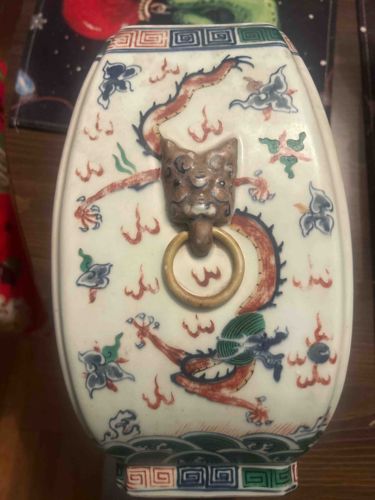
This is a porcelain vase of a flattened, quadrangular or baluster form, featuring a cream-colored glaze and polychrome enamel decorations. The central motif is a hand-painted five-clawed dragon in iron-red and green, surrounded by stylized flame wisps and auspicious clouds or butterflies in blue and green. A significant three-dimensional element is the applied biscuit-colored lion or 'taotie' mask handle, which holds a functional or decorative ring. The top and bottom of the vessel are framed by a geometric 'fret' or key-fret border in alternating blue, green, and red hues. The base features a stylized wave or scale pattern. Regarding condition, there is visible crazing throughout the glaze, suggesting age, along with some surface pitting and minor enamel loss consistent with a 20th-century piece made in an earlier style. The craftsmanship shows a mix of molded and hand-painted techniques, aiming for a rustic or archaistic aesthetic characteristic of late Qing or early Republic period reproductions. No visible maker's marks are present in the view, but the overall style is a pastiche of Ming and Qing dynasty export porcelain.
AI-Generated Appraisal Disclaimer
Estimated Value
$400-$700
Basic Information
Category
Asian Antiques - Ceramics
Appraised On
December 29, 2025
Estimated Value
$400-$700
Item Description
This is a porcelain vase of a flattened, quadrangular or baluster form, featuring a cream-colored glaze and polychrome enamel decorations. The central motif is a hand-painted five-clawed dragon in iron-red and green, surrounded by stylized flame wisps and auspicious clouds or butterflies in blue and green. A significant three-dimensional element is the applied biscuit-colored lion or 'taotie' mask handle, which holds a functional or decorative ring. The top and bottom of the vessel are framed by a geometric 'fret' or key-fret border in alternating blue, green, and red hues. The base features a stylized wave or scale pattern. Regarding condition, there is visible crazing throughout the glaze, suggesting age, along with some surface pitting and minor enamel loss consistent with a 20th-century piece made in an earlier style. The craftsmanship shows a mix of molded and hand-painted techniques, aiming for a rustic or archaistic aesthetic characteristic of late Qing or early Republic period reproductions. No visible maker's marks are present in the view, but the overall style is a pastiche of Ming and Qing dynasty export porcelain.
Get Your Items Appraised
Instant estimates of your treasures with AI-powered instant appraisals