AI Appraisal Estimate

AI-generated estimates · not official valuations

From the user

What was submitted

Photo and notes provided by the user — not generated by AI

Submitted item photo
Submitted photo · May 28, 2026

User's notes

No additional notes provided.

AI analysis below

AI appraisal

AI analysis & estimate

AI-Generated · Verify before acting

Everything below is generated by AI for informational purposes only. AI can make mistakes — the AI may misidentify items or misattribute them (artist, maker, brand, designer, origin, era). This is not an official valuation and should not be used for insurance, sale, tax, estate, legal, or lending purposes — or any decision requiring a certified appraisal. It is not an authoritative claim about any person, brand, or rights holder — do not share or rely on it as a factual statement about a third party. Always consult qualified professionals before making financial decisions.

Read the full disclaimer

AI Identification

·Not independently authenticated·Verify before acting

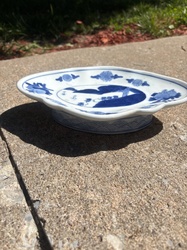
Japanese Imari Porcelain Punch Bowl

Asian Antiques / Ceramics

AI Estimated Value

·Not an official valuation·Verify before acting

$400 - $600 USD

As of May 28, 2026

AI Item Analysis

·AI can make mistakes·Verify before acting
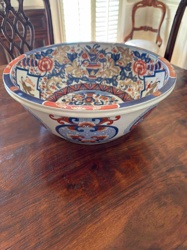
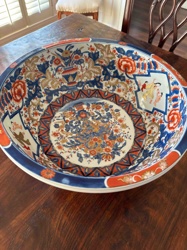
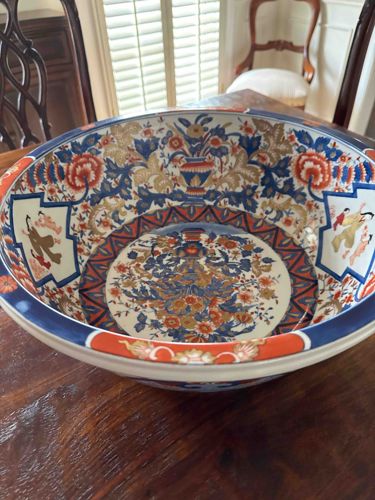
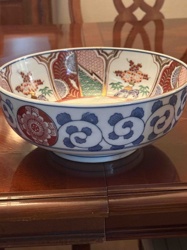
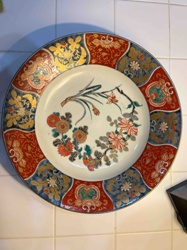
This is a large, ornate Japanese Imari-style porcelain punch bowl, likely dating from the Meiji period (1868–1912) or the early 20th century. The bowl features a classic 'Imari' color palette consisting of underglaze cobalt blue, overglaze iron red, and lavish gold (gilt) highlights on a white porcelain ground. The interior is densely decorated with traditional motifs: the central medallion (well) displays a large floral basket or 'ikebana' arrangement surrounded by scrolling foliage. The inner walls are divided into geometric panels and lobed cartouches. Two prominent cartouches feature 'bijin' (beautiful women) or figures in kimonos, set against a plain light ground to provide contrast with the busy floral surrounds. The floral work includes peonies and chrysanthemums, symbols of prosperity and longevity. The rim is broad and slightly flared, decorated with repeating floral patterns and solid blocks of cobalt and red. The glaze appears bright with a characteristic slight blue-grey tint common in high-fired Japanese porcelain. Regarding condition, there is visible minor gilt loss on the rim consistent with age and handling. There are no obvious cracks or large chips visible from this angle, though fine surface scratches from use might be present. The level of detail and the use of hand-painted enamels over the printed blue outlines indicate a mid-to-high quality production meant for the export or upper-middle-class domestic market.
AI Appraisal Report

·AI can make mistakes·Verify before acting
Based on the visual evidence provided, I have assessed this Japanese Imari-style porcelain punch bowl as a likely product of the late Meiji period (1868–1912) or the Taisho era (1912–1926). The piece is a quintessential example of Satsuma-influenced export ware, distinguished by its vibrant underglaze cobalt, overglaze iron red, and extensive gilding. The decorative program is classic, featuring the central ikebana motif and alternating cartouches of bijin (beautiful women) or courtiers, which suggests it was targeted specifically toward Western tastes of the era. The condition appears generally good for its age. The glaze retains a strong sheen, and the primary structural integrity seems intact with no large chips or hairlines visible in the images. However, there is noticeable wear to the gilt on the rim and high points of relief, which is standard for utilitarian pieces of this vintage. The painting quality is mid-range; while the enamels are bright, the execution lacks the extreme precision of imperial-grade works. Market demand for large Imari punch bowls remains steady but selective. While 'bijin' panels are desirable, the market is saturated with mid-quality export wares. Comparable pieces of this size (likely 10-12 inches in diameter) typically realize between $400 and $600 at auction, though retail prices in antique galleries may be higher. **Limitations:** This appraisal is provisional based on digital imagery. To confirm the upper end of the valuation, I would need to physically inspect the foot rim for a specific kiln mark or the 'Fuki Choshun' (Wealth and Eternal Spring) mark. I would also need to examine the piece under UV light to rule out professional restoration to the rim, which can be invisible to the naked eye.

Get your items appraised

Instant estimates of your treasures with AI-powered appraisals

Browse More Appraisals