AI estimate as of December 10, 2025 · verify with a professional before acting
AI-Generated · Verify before acting
Everything on this page is generated by AI for informational purposes only. AI can make mistakes — the AI may misidentify items or misattribute them (artist, maker, brand, designer, origin, era). This is not an official valuation and should not be used for insurance, sale, tax, estate, legal, or lending purposes — or any decision requiring a certified appraisal. It is not an authoritative claim about any person, brand, or rights holder — do not share or rely on it as a factual statement about a third party. Always consult qualified professionals before making financial decisions.
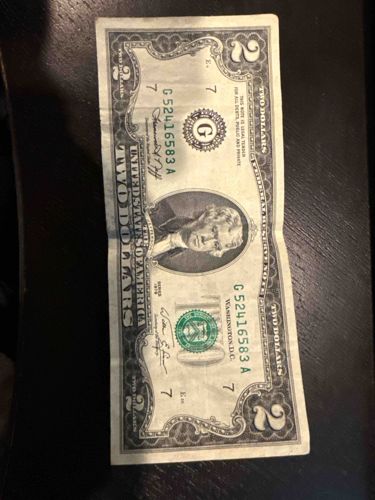
The item is a United States Two-Dollar Bill, specifically identifiable as a Series 1976 note due to the visible 'Series 1976' printing beneath the portrait of Thomas Jefferson. The front (obverse) of the bill is depicted, featuring a prominent, centrally located portrait of Thomas Jefferson. To the right of Jefferson's portrait, the green Treasury seal is visible, with the motto 'IN GOD WE TRUST' and 'WASHINGTON D.C.' printed above and below it, respectively. The Federal Reserve System seal, represented by a black circle with the letter 'G' inside, is positioned to the left of Jefferson's portrait. The serial number 'G52416583A' is printed twice, once vertically on the right side and once horizontally on the left side, indicating it was issued by the Federal Reserve Bank of Chicago. The signatures of the Treasurer of the United States and the Secretary of the Treasury are present below the Federal Reserve System seal and to the right of Jefferson's portrait. The denomination 'TWO DOLLARS' is present along the bottom border and also runs vertically along the left and right edges. The number '2' is in each of the four corners, surrounded by an ornate border design. The paper itself appears to be a standard cotton-linen blend used for U.S. currency. In terms of condition, the bill exhibits signs of circulation, including central creasing and minor wrinkles, visible particularly across Jefferson’s portrait. The edges appear slightly softened but without significant tears or fraying. The overall color is consistent with circulated currency, a pale greenish-white with green and black ink printing. There are no obvious repairs or major damage, though the 'crispness' of a new bill is absent. The craftsmanship is consistent with official U.S. government printing, characterized by intricate line work and precise detailing.
AI Appraisal Report
I have examined the provided image of this United States Two-Dollar Bill, Series 1976. Authenticity, based on the visible features such as the portrait of Thomas Jefferson, Treasury seal, Federal Reserve System seal (G for Chicago), serial number format, and general design elements, appears to be consistent with a genuine U.S. banknote. The craftsmanship reflects official government printing. However, it is crucial to state that full authentication always requires in-person examination to verify paper composition, ink characteristics, security features not visible in static images (like watermarks or embedded security threads if applicable to this series), and to rule out sophisticated counterfeits. Provenance documentation, while not usually associated with common circulated currency, could sometimes add an extra layer of verification in unique cases.
Regarding condition, this bill shows clear signs of circulation. I observe central creasing and minor wrinkles, particularly across Jefferson's portrait, which indicate active use. The edges appear softened, but without significant tears or fraying. The overall color aligns with typical circulated currency. These factors place the bill in a circulated grade, likely Very Fine (VF) to Extremely Fine (EF) if viewed generously, but certainly not Uncirculated or AU.
From a market perspective, Series 1976 Two-Dollar bills were widely issued in large quantities. This specific note, from the Federal Reserve Bank of Chicago, is not considered rare. Unless it possesses a rare \
serial number (such as a \
star note, a very low serial number, or a \
radar/ladder note, none of which are evident here) or a significant error, its value typically remains very close to its face value. Demand for common circulated examples of this series is low among collectors, as they are readily available in higher grades.
Therefore, considering its circulated condition and lack of any apparent rarity factors, the appraisal value for this Series 1976 Two-Dollar bill is approximately its face value, or slightly above, for an interested collector. Without physical inspection, I cannot confirm nuances like paper crispness or subtle ink anomalies that could slightly adjust the grade upwards or downwards within the circulated range.