AI Appraisal Estimate

AI-generated estimates · not official valuations

From the user

What was submitted

Photo and notes provided by the user — not generated by AI

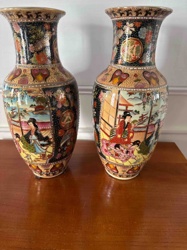
Submitted item photo
Submitted photo · June 20, 2026

User's notes

Hand painted porcelain, made in china

AI analysis below

AI appraisal

AI analysis & estimate

AI-Generated · Verify before acting

Everything below is generated by AI for informational purposes only. AI can make mistakes — the AI may misidentify items or misattribute them (artist, maker, brand, designer, origin, era). This is not an official valuation and should not be used for insurance, sale, tax, estate, legal, or lending purposes — or any decision requiring a certified appraisal. It is not an authoritative claim about any person, brand, or rights holder — do not share or rely on it as a factual statement about a third party. Always consult qualified professionals before making financial decisions.

Note

This analysis also relies on unverified notes provided by the user, which may be incomplete or inaccurate and could affect the result.

Read the full disclaimer

AI Identification

·Not independently authenticated·Verify before acting

Famille Rose Style Chinese Porcelain Square Baluster Vase

Asian Art and Decorative Ceramics

AI Estimated Value

·Not an official valuation·Verify before acting

$150 - $250

As of June 20, 2026

AI Item Analysis

·AI can make mistakes·Verify before acting
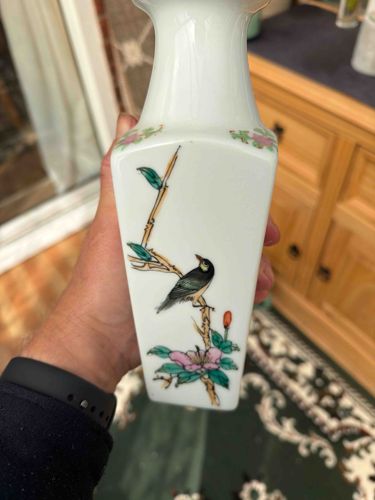
This is a hand-painted Chinese porcelain vase featuring a traditional 'bird and flower' motif. The vase is constructed in a square baluster form, tapering from wide shoulders down to a narrower base, with a cylindrical neck. It is crafted from white vitrified porcelain with a smooth, clear glaze. The central decoration depicts a small songbird perched on a blossoming branch, likely a plum or cherry blossom. The palette includes characteristic famille rose enamels: soft pinks for the petals, varied shades of green for the foliage, and earthy ochre tones for the woody stems. The bird is rendered with fine line work in black and grey, showcasing delicate brushwork typical of mid-to-late 20th-century Chinese decorative arts. Small floral accents are also visible at the corners of the shoulder. The glaze appears consistent, though there is a small surface irregularity or possible kiln grit near the center-right of the square face shown. The condition appears sound with no visible cracks or significant chips on the main body, though there is some light wear to the enamel on the branch. Based on the style and execution, this piece likely dates to the export period of the 1960s to 1980s. The level of detail suggests a commercial-grade hand-painted item intended for the international market rather than an imperial or scholar's piece, but it retains the charm of traditional Chinese aesthetic principles.
AI Appraisal Report

·AI can make mistakes·Verify before acting
I have examined the digital representations of this square baluster 'bird and flower' vase. My visual analysis confirms it as a mid-to-late 20th-century Chinese export piece, likely produced in Jingdezhen during the 1960s–1980s. The application of famille rose enamels and the stylistic rendering of the songbird align with the 'Zhongguo Zhi Zao' (Made in China) era of production. The condition appears fair to good; while the porcelain body remains structurally sound, I noted minor surface irregularities (kiln grit) and slight enamel wear on the dendritic elements, which are typical for export-grade wares of this period. The market for 20th-century Chinese export porcelain is currently steady but saturated. Comparables for this specific form and motif frequently appear in regional estate auctions and online marketplaces within the $100 to $300 range. Its value is driven by its decorative appeal rather than rarity, as these were produced in significant quantities for Western interior design markets. Limitations: This appraisal is based solely on digital images. Without an in-person inspection, I cannot verify the presence of hidden hairlines, professional restorations under UV light, or the exact composition of the paste. A definitive authentication would require examining the foot rim for vitrification levels and identifying any specific factory marks or 'iron-red' stamps on the base. While the piece shows the charm of traditional Chinese aesthetics, its commercial origin limits its upward potential compared to earlier Republic period or Qing Dynasty examples.

Get your items appraised

Instant estimates of your treasures with AI-powered appraisals

Browse More Appraisals