These notes were written by the person who submitted this item. Appraiser.AI has not verified them, and the AI's identification and estimate may rely on them.
AI Estimated Value
Not an official valuation
$100-250
AI estimate as of August 31, 2025 · verify with a professional before acting
AI-Generated · Verify before acting
Everything on this page is generated by AI for informational purposes only. AI can make mistakes — the AI may misidentify items or misattribute them (artist, maker, brand, designer, origin, era). This is not an official valuation and should not be used for insurance, sale, tax, estate, legal, or lending purposes — or any decision requiring a certified appraisal. It is not an authoritative claim about any person, brand, or rights holder — do not share or rely on it as a factual statement about a third party. Always consult qualified professionals before making financial decisions.
This analysis also relies on unverified notes provided by the user, which may be incomplete or inaccurate and could affect the result.
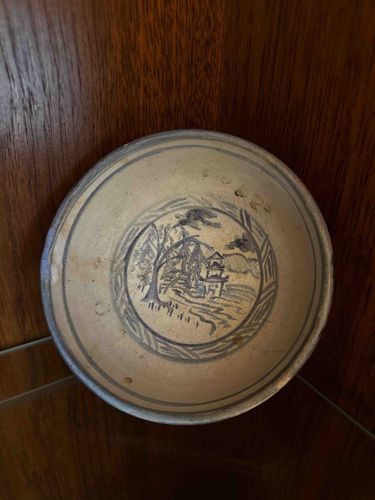
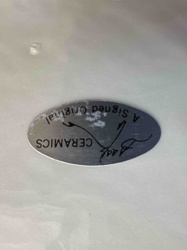
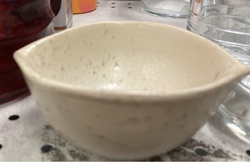
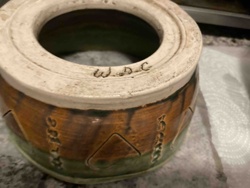
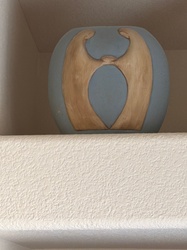
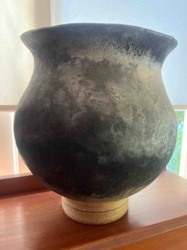
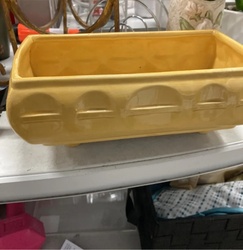
This item is a circular, shallow ceramic dish or bowl, likely a saucer or small plate, with distinctive hand-painted decoration. Its predominant color appears to be an off-white or light tan, possibly an aged celadon or bisque finish, with blue-grey underglaze or slip-painted details. The central motif depicts a traditional Asian landscape scene within a circular border. This scene features a multi-tiered pagoda or temple structure nestled amidst rolling hills and a prominent large tree, possibly a weeping willow or similar deciduous variety. The brushwork for the landscape appears somewhat rustic and gestural, indicating a handmade quality. Surrounding the central medallion is a decorative band, which appears to have a stylized wave or linear pattern. The rim of the dish is slightly raised, forming a defined edge, and shows some variation in thickness, further suggesting hand-craftsmanship. The overall condition suggests age, with visible wear, scuffs, and possibly some small chips or imperfections along the rim and surface, indicative of its history and use. The surface also exhibits a visible patina, consistent with older ceramic pieces. There are no clear maker's marks or signatures visible from this perspective, but the style strongly suggests an East Asian, likely Chinese or Japanese, origin, possibly from the 18th to early 20th century given the traditional landscape and apparent hand-painted nature. The quality of the glaze and painting, while charming, suggests a utilitarian or folk art piece rather than high-end imperial ware, but its age and hand-made character contribute to its unique appeal.
AI Appraisal Report
Based on my examination of the provided image, this hand-painted ceramic dish, likely East Asian (Chinese or Japanese), exhibits characteristics consistent with 18th to early 20th-century folk art or utilitarian ware. The hand-crafted nature is evident in the slightly irregular form and the gestural brushwork of the landscape motif. The condition, showing visible wear, scuffs, and possibly minor imperfections, suggests age and prior use. This patina is generally desirable for antique ceramics as it speaks to the item’s history.
Authenticator notes: Without physical examination, I cannot definitively confirm authenticity, precise origin, or exact age. An in-person inspection would allow for tactile assessment of the glaze, clay body, and painting technique, as well as examination for hidden repairs or more subtle maker's marks. Microscopic analysis of the glaze crazing and pigment composition, or thermoluminescence dating, could provide more conclusive evidence of age. Furthermore, full provenance documentation (e.g., bills of sale, exhibition records) would significantly enhance authentication.
In terms of market conditions, similar hand-painted Asian utilitarian ceramics with traditional motifs, especially those exhibiting wear and lacking definitive attributions, typically fall within a modest range. The appeal lies in their decorative quality and history, rather than extreme rarity or imperial provenance. Demand for such pieces is steady among collectors of Asian antiques and decorative arts, but it is not high-end. Comparables in the market, often found at regional antique fairs or online platforms, reinforce this valuation for charming, unauthenticated examples.