These notes were written by the person who submitted this item. Appraiser.AI has not verified them, and the AI's identification and estimate may rely on them.
AI Estimated Value
Not an official valuation
$30-$60
AI estimate as of July 30, 2026 · verify with a professional before acting
AI-Generated · Verify before acting
Everything on this page is generated by AI for informational purposes only. AI can make mistakes — the AI may misidentify items or misattribute them (artist, maker, brand, designer, origin, era). This is not an official valuation and should not be used for insurance, sale, tax, estate, legal, or lending purposes — or any decision requiring a certified appraisal. It is not an authoritative claim about any person, brand, or rights holder — do not share or rely on it as a factual statement about a third party. Always consult qualified professionals before making financial decisions.
This analysis also relies on unverified notes provided by the user, which may be incomplete or inaccurate and could affect the result.
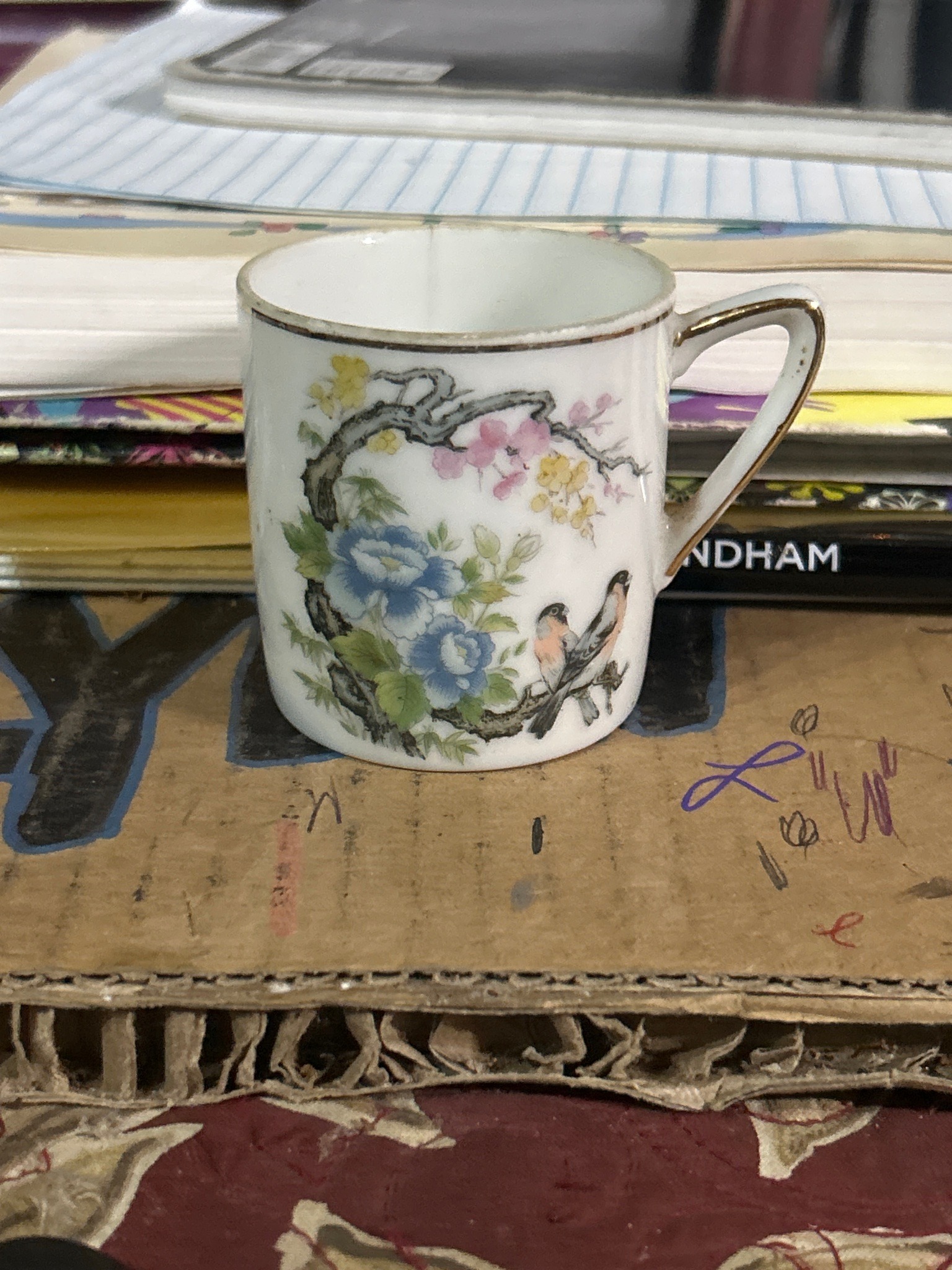
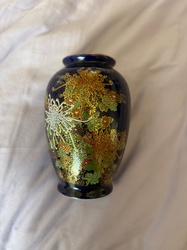
This item is a small ceramic cup featuring a cylindrical body and an angled loop handle. The exterior exhibits a hand-painted or transferred polychrome decorative motif depicting gnarled branches, large blue and yellow flowers, pink blossoms, and two small birds perched on a branch. The rim and handle are accented with a gilded line, though the gold paint shows signs of wear and fading. Physically, the cup displays a notable vertical hairline crack running down the upper rim on the side facing the viewer, which is a significant condition issue affecting its structural integrity and stability. The ceramic base appears to be a white earthenware or porcelain, but specific manufacturing details, maker's marks, stamps, or backstamps are not visible from this photographic angle, leaving the exact origin and manufacturing date unverified. Stylistically, the decorative elements appear consistent with general export ceramics or decorative souvenir ware, but this is merely a stylistic observation rather than a dated fact. The owner's supplied context describes the piece simply as a 'small cup,' which is an unverified user-supplied claim. Because no maker's mark is visible in the image to establish a reliable attribution, hedged language is used in the item name to prevent misidentification. Quality indicators such as the application of gilding and detailed floral painting suggest decorative intent, but physical inspection would be required to assess the piece fully.
AI Appraisal Report
Based on what I can see in the provided image, this small ceramic cup exhibits a cylindrical body, an angled loop handle, and a polychrome decorative motif featuring gnarled branches, flowers, and birds, accented with faded gilding. Per user submission, the piece is simply described as a 'small cup.' I cannot verify from a photo whether the attribution to any specific Asian decorative style or period is correct, as specific manufacturing details, maker's marks, or backstamps are not visible from this viewing angle. Furthermore, the cup displays a notable vertical hairline crack running down the upper rim, which is a significant condition issue negatively affecting its structural integrity and stability. My appraisal value range of $30 to $60 assumes the decorative style is consistent with general export ceramics or decorative souvenir ware. If physical inspection reveals the piece to be a later reproduction, replica, copy, or purely 'in the style of' rather than a period export piece, or due to the heavy impact of the structural crack, the value would likely drop to the $10-$20 range primarily as a decorative curio. General market demand for small, damaged export ceramic pieces of this type is modest. To confirm authenticity, age, and potential origin, one would need in-person examination by a qualified specialist, microscopic analysis of the ceramic body and pigments, and a thorough search for any faint or obscured maker's marks.