AI estimate as of October 14, 2025 · verify with a professional before acting
AI-Generated · Verify before acting
Everything on this page is generated by AI for informational purposes only. AI can make mistakes — the AI may misidentify items or misattribute them (artist, maker, brand, designer, origin, era). This is not an official valuation and should not be used for insurance, sale, tax, estate, legal, or lending purposes — or any decision requiring a certified appraisal. It is not an authoritative claim about any person, brand, or rights holder — do not share or rely on it as a factual statement about a third party. Always consult qualified professionals before making financial decisions.
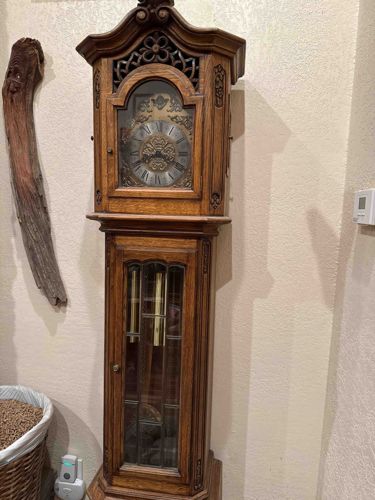
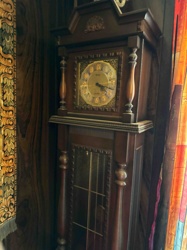
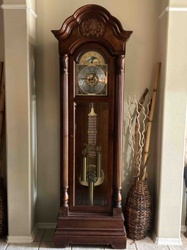
This is a tall, free-standing grandfather clock, likely crafted from oak or a similar hardwood, exhibiting a warm, medium-brown finish with visible wood grain. The overall style suggests a Victorian or early 20th-century aesthetic, characterized by its ornate carvings and classic design elements. The clock's hood features a gracefully curved pediment with a central carved element, possibly a floral motif, and intricate fretwork below the crown. The upper section enclosing the clock face has an arched glass door, allowing a view of the brass-toned, elaborately decorated dial. The dial itself has Roman numerals for hours, a smaller inner ring for minutes, and decorative filigree surrounding the central hand mechanism. The hands appear to be a dark metal, possibly blued steel. The waist of the clock is a rectangular body featuring a long, arched glass door with multiple pane divisions, through which the pendulum and weights are visible. The pendulum appears to be a polished brass or gold-toned rod with a matching bob at its base. Two brass-toned weight shells are also visible, hanging vertically. The base of the clock is simpler, likely a sturdy plinth. Decorative carving is also present on the pilasters flanking the upper glass door, showing a continuation of the ornate style. The clock appears to be in relatively good condition for its age, with a consistent patina across the wood. There are no obvious signs of significant damage like major cracks or missing pieces, though typical wear and tear associated with age would be expected. The craftsmanship appears to be of good quality, indicated by the detailed carvings and fitted joinery.
AI Appraisal Report
Based on my visual examination of the provided image, this Victorian-style grandfather clock, likely crafted from oak, appears to be in relatively good condition for its age. The consistent patina suggests it has been well-maintained, and I observe no obvious signs of significant damage such as major cracks or missing structural components. The ornate carvings, fretwork, and detailed brass-toned dial with Roman numerals align well with typical Victorian or early 20th-century aesthetics. The craftsmanship, evident in the detailed carvings and visible joinery, appears to be of good quality, contributing positively to its perceived value.
Market conditions for antique grandfather clocks of this style are generally stable, with demand often driven by collectors or individuals seeking statement pieces for traditional interiors. Comparable pieces featuring similar ornate details, materials, and apparent condition typically retail in the $800 to $1,500 range, sometimes more for pieces with exceptional provenance or functionality. While not exceptionally rare, clocks of this quality from the period are becoming less common in pristine condition, which influences demand modestly.
Factors impacting value include the wood species (oak is desirable), the intactness of all decorative elements, and the functionality of the clock movement. The presence of the original brass pendulum and weights is a positive. However, it is crucial to note the limitations of image-based appraisal. I cannot verify the authenticity of the movement itself – whether it is original to the case, its manufacturer, or its functional condition. The most significant factor impacting its ultimate value would be the internal mechanism's operational status and originality. For full authentication and a more precise valuation, an in-person examination would be required to assess the movement's condition, manufacturer marks, material integrity under different lighting, and to confirm the absence of repairs or restorations not visible in the image. Provenance documentation, if available, would also significantly enhance authenticity verification.