AI estimate as of September 6, 2025 · verify with a professional before acting
AI-Generated · Verify before acting
Everything on this page is generated by AI for informational purposes only. AI can make mistakes — the AI may misidentify items or misattribute them (artist, maker, brand, designer, origin, era). This is not an official valuation and should not be used for insurance, sale, tax, estate, legal, or lending purposes — or any decision requiring a certified appraisal. It is not an authoritative claim about any person, brand, or rights holder — do not share or rely on it as a factual statement about a third party. Always consult qualified professionals before making financial decisions.
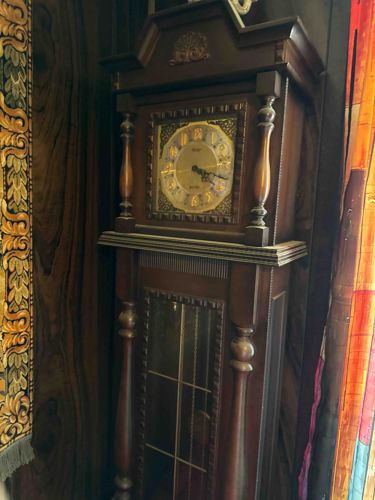
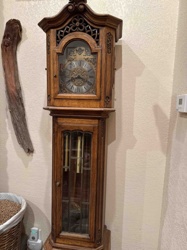
This is a full-size grandfather clock, likely constructed from a dark-stained hardwood, possibly mahogany or a similar rich-toned timber, given its reddish-brown hue. The overall design suggests a traditional or possibly Victorian-revival style, dating perhaps from the late 20th century to early 21st century. The clock stands tall and appears to have a multi-tiered or stepped top, adorned with an ornate, possibly carved or molded pediment featuring decorative scrollwork, which adds to its classic aesthetic. The clock face is round, gold-toned, and features Arabic numerals for the hours. The hands are dark and clearly visible against the light face. It is encased within a square or rectangular bezel that has decorative fluting or reeding along its edges. Flanked on either side of the clock face are turned wooden columns or pilasters, adding architectural interest to the upper section. Below the main clock mechanism, the body of the clock features a long, glazed door, allowing visibility into what would typically be the space for weights and a swinging pendulum. The glass in this lower door appears to have a grid or mullion pattern, possibly indicating multiple panes or a decorative overlay. More turned decorative elements are present on either side of this lower door, mirroring the upper columns but with a slightly different form. The entire piece seems to be in good, well-maintained condition with no obvious signs of significant damage, heavy wear, or repairs visible from the image. The wood exhibits a uniform finish and appears free of major scratches or chips. The brass or gold-tone elements of the clock face also appear clean and untarnished. The craftsmanship, evident in the turning and paneling, suggests a commercially produced but well-made piece intended for a traditional home interior.
AI Appraisal Report
Based on my visual examination of the provided image, this Traditional Wooden Grandfather Clock presents as a well-maintained example of a late 20th to early 21st-century commercially produced timepiece. The dark-stained hardwood, likely mahogany or a similar timber, exhibits a consistent finish, suggesting good care. I observe no major condition issues such as significant scratches, chips, or veneer lifting, and the brass/gold-toned elements appear clean. The craftsmanship, evident in the turned columns, fluted bezel, and decorative pediment with scrollwork, indicates a mass-produced but quality furniture piece. The glazed lower door with its mullion pattern adds to its classic appeal.
In terms of market conditions, traditional grandfather clocks, particularly those from the late 20th century, generally face a moderate demand. While they are not rare, well-preserved examples like this one retain value, especially if they are in working order. Comparables would include similar Mass-produced Traditional Grandfather Clocks from brands like Howard Miller or Ridgeway. The primary factors impacting its value are its good cosmetic condition and the likelihood of its mechanical functionality (which cannot be confirmed visually). The aesthetic appeal aligns with classic home decor, broadening its potential market.
Limitations in authenticity verification are significant with image-only appraisal. I cannot definitively confirm the wood species, the manufacturer, or the specific age without in-person inspection. Crucially, the functional status of the clock mechanism (chimes, timekeeping accuracy, pendulum swing, weight system) is unknown. Full authentication would require physical inspection to assess the movement's condition, operation, and type (e.g., Kieninger, Hermle), and to confirm the absence of internal damage or repairs. Provenance documentation, such as original purchase receipts or service records, would also provide valuable context, especially for determining exact age and manufacturer. Scientific testing of the wood or metal components is typically not warranted for items of this common vintage and type unless a specific high-value claim is being made.