AI estimate as of November 17, 2025 · verify with a professional before acting
AI-Generated · Verify before acting
Everything on this page is generated by AI for informational purposes only. AI can make mistakes — the AI may misidentify items or misattribute them (artist, maker, brand, designer, origin, era). This is not an official valuation and should not be used for insurance, sale, tax, estate, legal, or lending purposes — or any decision requiring a certified appraisal. It is not an authoritative claim about any person, brand, or rights holder — do not share or rely on it as a factual statement about a third party. Always consult qualified professionals before making financial decisions.
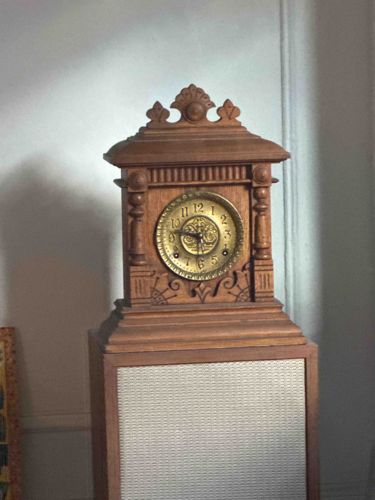
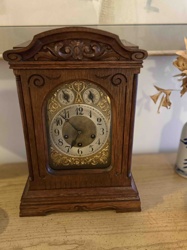
This item is an antique wooden mantel clock, likely crafted from oak or a similar hardwood, exhibiting a rich, medium-brown finish. The clock's case features an ornate architectural design, characterized by a stepped and peaked pediment top with decorative carvings, including what appears to be a central finial or cartouche flanked by two smaller, leaf-like scrolls. Below the pediment, the case has an overhanging cornice with a fluted frieze. The main body of the clock is rectangular with vertical pilasters on either side, also adorned with fluting or reeding. The clock face is brass-colored, featuring black Arabic numerals and intricate filigree hands. The brass appears to have a natural patina consistent with age. Below the clock face, there is a decorative apron with carved scrollwork and possibly floral motifs. The entire clock mechanism itself sits atop a larger, simpler wooden base or pedestal which also appears to be made of the same wood type. This pedestal is box-shaped and features a light-colored, possibly woven or perforated, panel on its front face. The overall construction suggests a late 19th to early 20th-century style, possibly Arts and Crafts or an American Victorian influence. Condition-wise, the wood shows a consistent color and finish, indicating good preservation, though minor surface wear or dust might be present given its age. No obvious cracks, chips, or significant damage are visible, and the carvings appear well-defined, suggesting quality craftsmanship. The metal elements of the clock face show natural oxidation which contributes to its antique aesthetic.
AI Appraisal Report
Based on my visual examination of the antique wooden mantel clock on a pedestal, I assess its condition to be good for its age. The rich, medium-brown finish appears well-preserved across the oak or similar hardwood, with consistent color and no visible major cracks, chips, or significant damage. The ornate architectural design, including the stepped pediment with carvings, fluted frieze, pilasters, and carved apron, suggests quality craftsmanship. The brass-colored clock face with black Arabic numerals and filigree hands shows a natural patina, consistent with an antique aesthetic and normal oxidation. The overall style points to a late 19th to early 20th-century origin, possibly Arts and Crafts or American Victorian. The inclusion of the original, matching pedestal enhances its display value.
In terms of market conditions, mantel clocks from this period are generally present in the antique market, though those in good, complete condition like this example, especially with their original pedestal, tend to command better prices. Demand for such pieces is steady among collectors and those seeking period-appropriate decor, but they are not exceptionally rare. Factors impacting value include the quality of the wood and carvings, the completeness (original pedestal), and the overall state of preservation. The aesthetic appeal of its ornate design is also a positive.
My primary limitation in this appraisal is the lack of physical inspection. I cannot definitively verify the clock's authenticity, the material beneath the finish, or the working condition of the internal mechanism solely from an image. For full authentication and a more precise valuation, an in-person examination is crucial to assess the movement's maker and functionality, any hidden repairs, the wood type, and the originality of all components. Provenance documentation, if available, would further substantiate its history and authenticity. Considering these factors, I estimate the appraisal value to be between $300 and $500.